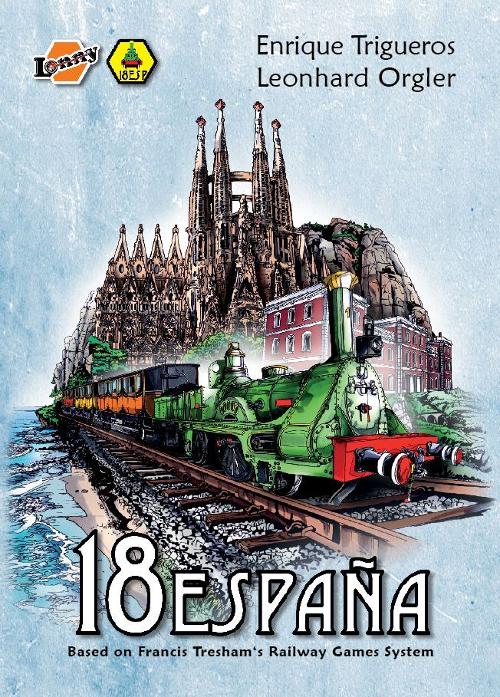
18España
Designer: Leonhard "Lonny" Orgler, Enrique Trigueros
The Iberian Peninsula with dual track gauges, rugged terrain, mines, and partial capitalization.
18ESP — Summary
Capitalization type
- Unusual capitalization tied to the float threshold: on floating (40% sold for majors, 100% for minors), the corporation immediately receives only the payment corresponding to the shares already sold at that point (4 shares for a major, 2 for a minor), not a full 10-share payment like in 1830. Once the first 5-train is bought (the "float_60" event), the float threshold for majors that haven't floated yet rises to 60%, and from then on they receive the full 10-share payment when they float.
Starting cash by player count
- 3 players: ₧860 starting cash (certificate limit: 27)
- 4 players: ₧650 starting cash (certificate limit: 20)
- 5 players: ₧520 starting cash (certificate limit: 16)
- 6 players: ₧440 starting cash (certificate limit: 13)
- The bank has unlimited money (there's no end-game trigger from the bank running dry)
End game triggers
- Bankruptcy isn't possible in this game (BANKRUPTCY_ALLOWED = false), and the bank has unlimited money, so neither of those two classic end-game reasons applies here
- Only trigger: the second 8-train is bought. The current operating round is finished (no more are added to that set) and the game ends at the next check
Number of phases
- 6 phases (2, 3, 4, 5, 6, 8), triggered by the purchase of the first train of each type
- Phase 3: the southern majors open up; privates can now be bought in by corporations for up to 150% of their value
- Phase 4: the maximum buy-in price for privates rises to 200% of their value
- Phase 5: all remaining privates close, minors stop operating, and the float threshold for majors rises from 40% to 60%
Train list and prices
- 2 train — ₧100 (11 available; rusts once the first 4-train is bought) — narrow-gauge "1+2" variant for crossing mountain passes by combining both gauges
- 3 train — ₧200 (9 available; rusts once the first 6-train is bought) — narrow-gauge "2+3" variant
- 4 train — ₧300 (7 available; rusts once the first 8-train is bought) — narrow-gauge "3+4" variant; buying it closes any private companies still owned by players
- 5 train — ₧500 (5 available) — narrow-gauge "4+5" variant; buying it closes all remaining privates, stops minors from operating, and raises the float threshold to 60%
- 6 train — ₧600 (3 available) — narrow-gauge "5+6" variant
- 8 train — ₧800 (unlimited) — narrow-gauge "6+8" variant, the last available type
- Every train has a narrow-gauge variant at the same price; "combined" trains crossing a mountain pass must stop both north and south of the map
List of private companies
- La Habana - Güines (P1) — ₧20, revenue ₧5 — ₧30 discount for laying a yellow mine tile or for shutting down a mine when upgrading that hex to green; closes once used
- Barcelona - Mataró (P2) — ₧60, revenue ₧10 — the corporation that buys it gets a free 2/1+2 train; closes once bought by a corporation
- Madrid - Aranjuez (El tren de la fresa) (P3) — ₧70, revenue ₧15 — if owned by a corporation at phase 5, it converts into a permanent 2-train that doesn't count against the train limit or fulfill the mandatory train-ownership requirement; its first run must go through Aranjuez and Madrid
- Alar del Rey - Santander (P4) — ₧100, revenue ₧20 — the major company that buys it can open the Alar del Rey mountain pass for free, or any other pass at a ₧40 discount; closes once used
- La Maquinista (P5) — ₧130, revenue ₧10 — grants six "tender" cards: up to five can be sold at ₧80 each (₧20 to the owner, ₧60 to the bank); a train with a tender assigned gains an extra stop at a town, harbor or mine; closes once bought by a minor or major
- Zafra - Huelva (P6, version A) — ₧160, revenue ₧20 — grants a 10% certificate of the southern corporation CRB (only one of the two P6 versions is present in any given game)
- Ferrocarril Vasco-Navarro (P6, version B) — ₧160, revenue ₧20 — grants a 10% certificate of a randomly chosen northern corporation
- Ferrocarril de Carreño (P7) — ₧170, revenue ₧30 — grants the president's share (20%) of a randomly chosen northern major; closes once that corporation buys its first train
List of corporations
- 18ESP defines up to 15 majors and 9 minors, but each game randomly removes 2 northern majors, 3 southern majors and 3 minors (unless the "core" variant is used), so the actual set of active corporations changes every time
- Southern majors (9): N — Norte — F24; MZA — Madrid a Zaragoza y Alicante — F24; A — Andaluces — E33; CRB — Ciudad Real a Badajoz — B26; MCP — Madrid a Cáceres y Portugal — F24; ZPB — Zaragoza a Pamplona y Barcelona — M21; GSSR — Great Southern of Spain — I29; AVT — Almansa a Valencia y Tarragona — K25; TBF — Tarragona a Barcelona y Francia — L22
- Northern majors (6): FdSB — Santander a Bilbao — I5; CFEA — Ferrocarriles Económicos de Asturias — D6; CFLG — Ferrocarril de Langreo — E3; FdLR — Ferrocarril de La Robla — H8; SFVA — Vasco Asturiana — D6; FdC — Ferrocarril del Cantábrico — I5
- Minors (9): MS — Mérida a Sevilla — C27; CM — Córdoba a Málaga — E29; SC — Sevilla a Jerez / Puerto Real a Cádiz — C31; AC — Albacete a Cartagena — H28; MZ — Madrid a Zaragoza — F24; ZP — Zaragoza a Pamplona — J20; CSE — Sur de España — H32; MH — Madrid a Hendaya — E21; CA — Central de Aragón — J20
Game-specific mechanics
- Dual track gauge (broad Iberian / narrow): northern and southern majors mostly use different gauges, and only trains with a "combined" variant can cross a mountain pass linking both networks
- Blocking tokens on mountain passes that must be paid off (cost varies by pass, ₧60-₧100) before they can be crossed
- Mines as a revenue source alternative to cities and towns
- Per-corporation goals (connect its destination, run to an off-board area, run to a harbor): each new goal reached grants extra capital (par price × number of goals reached so far) and an extra token
- "Minor" companies absorbable by the majors, with compensation to the shareholder and possible token retention
- Variable setup: corporations are randomly removed each game (unless the "core" variant is used)
- East/west and G/Bi-to-B/M route bonuses
Comparison with 1830
1. Setting and map: the Iberian Peninsula
1830 covers the northeastern USA. 18ESP is set on the Iberian Peninsula, with the Spanish railway network of
the 19th century as its backdrop. The map is rugged and reflects the real difficulty of building railway
lines across one of Europe's most orographically complex peninsulas: the Pyrenees, central mountain ranges,
and Andalusian highlands.
2. Dual track gauges: Iberian and narrow
In 1830 all track is equivalent and there is no gauge distinction. In 18ESP there are two distinct track
gauges: the Iberian gauge (the traditional Spanish gauge, wider than the European standard, adopted in the
19th century for stability on mountainous terrain) and the narrow gauge (used on mountain and regional
lines). Each corporation mostly runs one gauge, and only trains with the "combined" variant can cross a
mountain pass to link both networks.
3. Very demanding terrain
In 1830 terrain has a one-time cost but is not a dominant factor. In 18ESP the peninsula is mountainous and
hexes with difficult terrain (mountain ranges, high passes) are very expensive to build through. The
orography demands careful planning of every network extension, since direct routes tend to be the costliest
and alternatives through valleys or along the coast significantly lengthen distances.
4. Mines as revenue sources
In 1830 revenue comes exclusively from cities and towns. In 18ESP there are mine hexes that generate specific
income for trains that visit them. Connecting mines can be as profitable as, or more profitable than,
connecting cities, especially in areas where mines are clustered but terrain is difficult. These alternative
revenue sources change the logic of route design entirely.
5. Companies with historical Iberian routes
The game's companies recreate the great railways of 19th-century Spanish history: the companies that built
the radial lines from Madrid, the Mediterranean coastal lines, and the cross-border connections with France.
For players who know the Iberian railway network, the map and the companies resonate with real names and
routes, adding an extra layer of thematic recognition.
6. An 18xx with its own identity, not just a variant of 1830
The combination of dual track gauges, extreme terrain, and mines gives 18ESP a flavour very different from
the classic Anglo-Saxon 18xx games. Knowing 1830 is not enough to be a strong 18ESP player: managing terrain,
gauges, and mines forces you to rethink from scratch how a profitable railway network is designed.