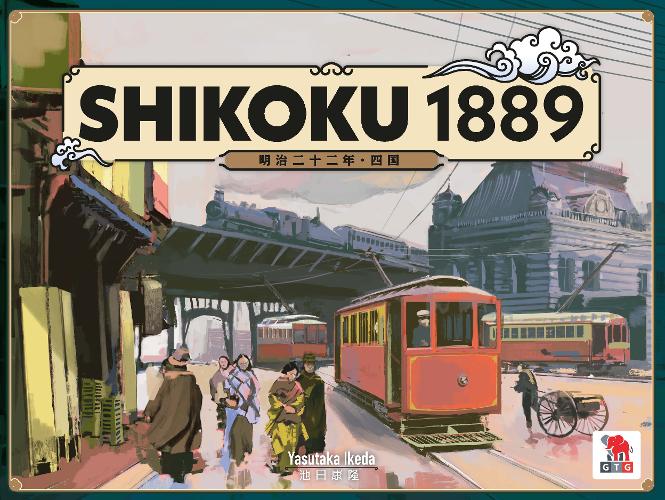
1889: History of Shikoku Railways
Designer: Yasutaka Ikeda
Shikoku, the compact and mountainous version of 1830 in Japan, with one fewer company and a shorter game.
1889 History of Shikoku Railways — Summary
Capitalization type
- Full capitalization: upon floating (50% sold), the company receives its entire capital (par price × 10) into the treasury at once.
Starting cash by player count
- 2 players: ¥420 starting cash
- 3 players: ¥420 starting cash
- 4 players: ¥420 starting cash
- 5 players: ¥390 starting cash
- 6 players: ¥390 starting cash
- The bank starts with ¥7,000, regardless of player count
End game triggers
- The bank runs out of money: the current full operating round set is finished
- A company goes bankrupt: immediate end
Number of phases
- 6 phases (2, 3, 4, 5, 6, D), triggered by the purchase of the first train of each type
Train list and prices
- 2 train — ¥80 (6 units; rusts with the first 4-train)
- 3 train — ¥180 (5 units; rusts with the first 6-train)
- 4 train — ¥300 (4 units; rusts with the first Diesel)
- 5 train — ¥450 (3 units; buying it closes the private companies)
- 6 train — ¥630 (2 units)
- Diesel (D) — ¥1,100, unlimited, available from the first 6-train; allows trading in old trains for a ¥300 discount
List of private companies
- Takamatsu E-Railroad (TR) — ¥20, revenue ¥5 — blocks Takamatsu (K4) while owned by a player
- Mitsubishi Ferry (MF) — ¥30, revenue ¥5 — allows placing the port tile on a coastal town (B11, G10, I12, or J9)
- Ehime Railway (ER) — ¥40, revenue ¥10 — when sold to a corporation, allows placing an extra green tile at Ohzu (C4)
- Sumitomo Mines Railway (SMR) — ¥50, revenue ¥15 — the owning corporation may ignore the building cost on mountain hexes without a river
- Dougo Railway (DR) — ¥60, revenue ¥15 — can be exchanged for a 10% share of Iyo Railway from the initial offering
- South Iyo Railway (SIR) — ¥80, revenue ¥20 — no special powers (removed in 2-player games, except in the beginner variant)
- Uno-Takamatsu Ferry (UTF) — ¥150, revenue ¥30 (¥50 from Phase 5 onward) — only with 4+ players; never closes while owned by a player, and can no longer be sold to a public company once the first 5-train is out
List of corporations
- Awa Railroad (AR) — home at K8
- Iyo Railway (IR) — home at E2
- Sanuki Railway (SR) — home at I2
- Takamatsu & Kotohira Electric Railway (KO) — home at K4
- Tosa Electric Railway (TR) — home at F9
- Tosa Kuroshio Railway (KU) — home at C10
- Uwajima Railway (UR) — home at B7
Game-specific mechanics
- One fewer company than in 1830, reducing the risk of a massive train rust wave
- Floats at 50% of shares sold (not 60%)
- In the stock round: buy+sell or sell+buy, but never sell-buy-sell in the same turn
- Semi-restrictive tile upgrades: the new tile must provide a new connection or increase the value of a city already reachable
- Optional "Beginner Game" rule with simplified privates distributed directly, not by auction
Comparison with 1830
1. Setting and a much smaller map
1830 covers the northeastern USA with a large map. 1889 takes place on Shikoku, the smallest of the
four main islands of Japan, with a much smaller map full of mountainous terrain that makes building expensive.
The rules engine is essentially that of 1830, but adapted to this smaller scale.
2. One fewer company than in 1830
Despite having the same number of trains as 1830, 1889 has one fewer company in play. Fewer companies
means fewer "slots" for trains, so it's harder for many trains to be bought all at once, triggering a
massive rust wave, unlike in 1830.
3. Companies float with 5 shares sold, not 6
In 1830 a company floats once 6 shares have been sold (60% of 10). In 1889 only 5 shares sold
are needed for a company to float, a lower threshold that slightly speeds up companies getting started compared
to 1830.
4. Restriction on the buy/sell order within the stock round turn
In 1830 there is no special restriction on the order of buying and selling within the same turn. In 1889 you can
buy and then sell, or sell and then buy, but you cannot sell, buy, and sell again in the same turn.
5. Semi-restrictive tile upgrades
In 1830 it's enough for the company to be able to reach the hex where the upgrade is placed (permissive rule).
In 1889 the new tile must additionally provide a new connection (new track) or increase the value of a
city the company can already reach.
6. Smaller bank and expensive terrain on a mountainous map
In 1830 the bank is sized for a much larger map and company scale. In 1889 the bank only has ¥7,000, and
Shikoku's terrain means that terrain costs weigh much more heavily on track-laying decisions than on the
relatively flat map of 1830's northeastern corridor.
7. A noticeably shorter game
The combination of a small map and a reduced bank means a game of 1889 tends to be noticeably shorter than
a game of 1830, while keeping all the depth of the system but in a more compact format. That's why it's often
recommended as "1830, but smaller" to those who already know 1830 and want a similar rules experience but
faster and more intense.