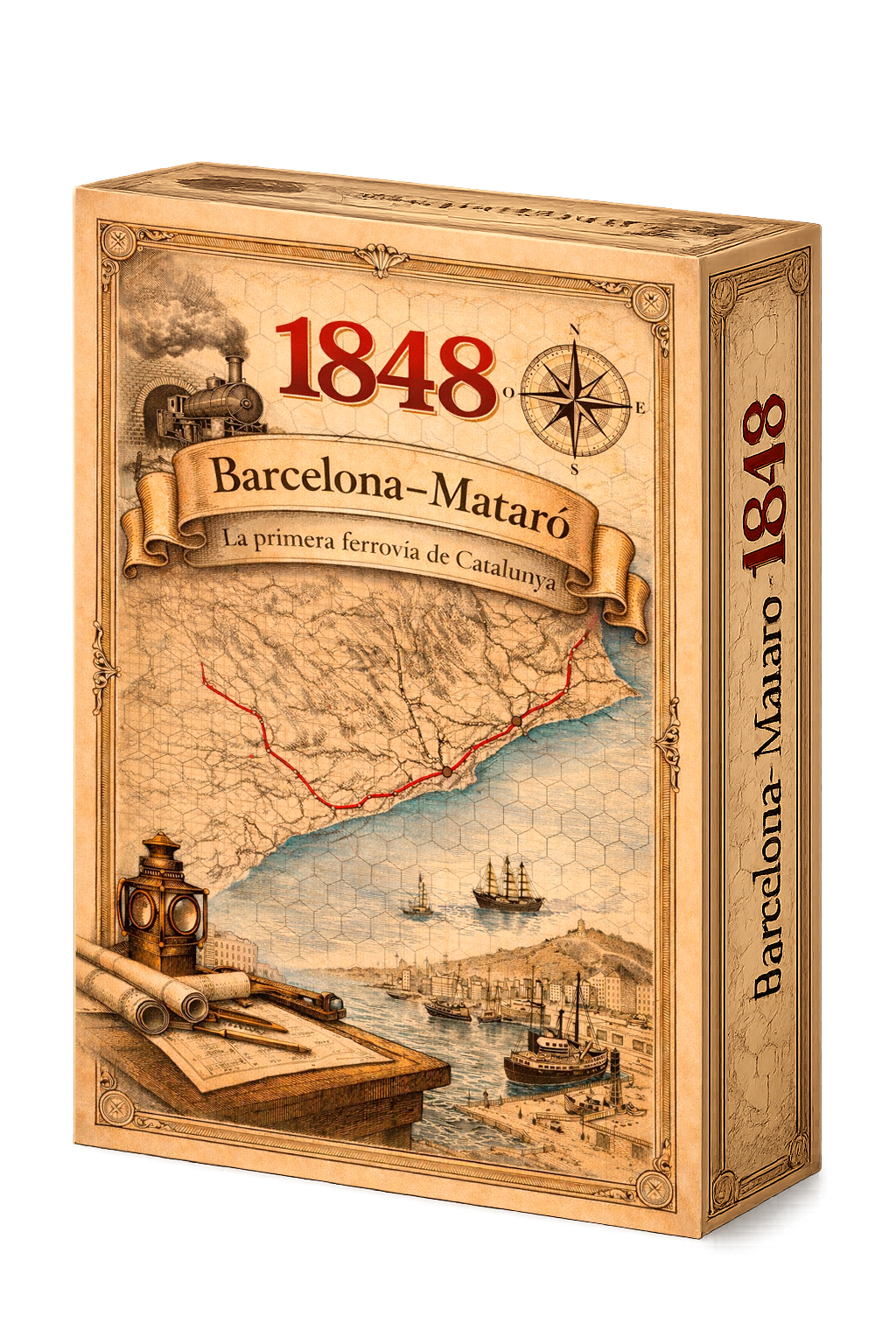
An 18xx railway game set in 1848 Catalonia. Build routes, manage railway companies, run trains, and dominate the stock market to accumulate the greatest fortune.
Sobre 1848 Barcelona-Mataró
1848 Barcelona-Mataróit's a family game18xx dissenyat per Jordi Salord, set in the inauguration of the first railway of the Iberian Peninsula: the line that joined Barcelona with Mataro on28 October 1848.
Players invest in Catalan railway companies, build road networks, buy trains and they manage dividends to maximize theirnet worthat the end of the game.
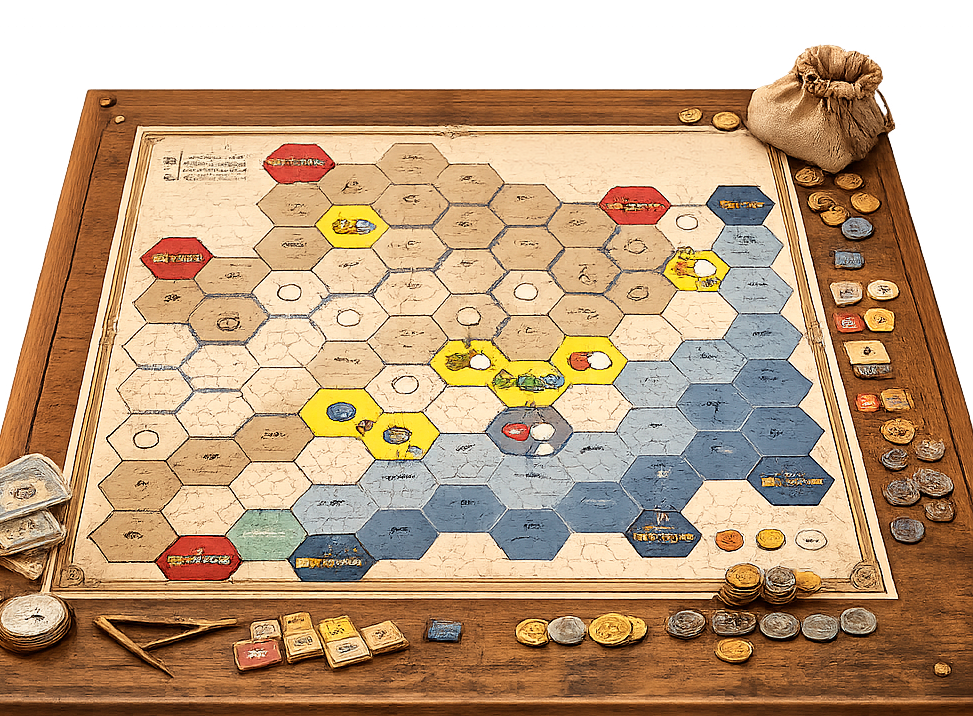
The board represents Catalonia in 1848 with two scales of road width:Spanish gauge(Iberian broad) andEurope gauge(European wide), simulating incompatibility real that goes mark the railway development in the Peninsula.
Mapa de Catalonia
The board divides Catalonia into hexagons. Each hex can contain roads, cities, or terrain mountainous The Perimeter hexes connect with ports, borders and external networks.
Com The Game works
Players buy and sell stocks by order. Each player can own up to 60% of a company Founding one requires an initial 20% (the director).
Companies lay tracks, place tokens, buy trains and build them circular The director decides whether to distribute dividends or retain them.
The price goes up if dividends are paid and down if they are withheld or the player sells. Determine the order of operation and the final value of the portfolio.
The game spans from 1848 to the beginning of the 20th century. It ends when the bank runs out or buys a train D. Whoever has the highest net worth wins: cash + value of the shares
The Roundof Operation
The company can place a token on a city on the map. Reserve the stop for his trains andbloqueja els rivals. The cost depends on the distance from the headquarters
The company places or upgrades up to1 sheet of roadin turn, connected to the existing network. Advanced tiles (yellow verd browngray) allow more stops per hex.
The company can buy trains from the bank or a rival. If the first purchase of a new one generation makes previous trains obsolete, the affected companies lose themwithout compensation. If the company can't pay, the director makes it his own pocket
Each train travels a route visiting themaximum of stopsthat allows your number The sum of the values of the stops is the collection. The train routes of the same company cannot share stops.
El director escull: (1) Pagar — ingressos repartits, preu puja. (2) Retenir — diners a caixa, preu baixa. (3) Dividends partial— yes company rules allow it.
7 Public Corporations
Each corporation has a natural runner and a strategic role in the game. The director owns 20% and take all operational decisions. TheCATis a company oflate game amb habilitats especials.
Barcelona Badalona Mataró Arenys Blanes
Barcelona Terrassa Sabadell Manresa Berga
Barcelona Martorell Manresa Berguedà colonies
Barcelona Granollers Girona Figueres France
Barcelona Sitges Tarragona Reus Tortosa
Barcelona Igualada Cervera Lleida Saragossa
BCN Girona · BCNTarragona · BCN Lleida
5 Empreses Privades
It is subasten at the beginning of the game. Donate a fixed income each SR and a special qualification to the owner
Historical Events
Each era brings events that reflect the economic and railway transformation of Catalonia In reveal a letter, its effect is immediately applied to all companies.
The Catalan textile industry is beginning to mechanize rapidly. The factories of Vallès and Barcelona they boost production, attract labor and capital, and convert Sabadell and Terrassa in engines of the new industrial economy.
The Catalan industrial bourgeoisie invests in infrastructure and new factories. The construction is accelerating throughout the territory, driven by the growing demand and the influx of private capital
Industrialization causes a strong growth of the populations close to Barcelona and of the centers factories Thousands of workers leave the countryside and settle in urban centers, transforming the human geography of Catalonia.
The General Railway Law promotes the massive construction of new lines across the state. Catalonia joins the European railway boom, and concessions multiply across the territory.
Mediterranean maritime trade grows thanks to steamships and the expansion of the Port of Barcelona. The connection between the factories of the interior and the European markets transforms the Catalan economy.
The Catalan bourgeoisie and European investors provide capital to expand railway companies. Confidence in the railway as a profitable business attracts new shareholders and finances network expansion.
An international financial crisis causes the bankruptcy of many railway companies and banks in Europe. In Catalonia, many companies are forced to cut dividends and halt ongoing works.
After the crisis, many small companies merge or are absorbed by larger networks. This concentration allows more efficient operations and supports the investments needed to modernize infrastructure.
The State begins to intervene more actively to stabilize and complete the railway network. Public subsidies for works in difficult terrain allow progress in areas where private capital alone would not have been enough.
The Catalan railway network progressively connects with international routes to France and Europe. The trans-Pyrenean line opens new markets and consolidates Catalonia as a gateway to the Iberian Peninsula.
Technical improvements in locomotives and infrastructure allow longer, faster, and more efficient trains. New steam engines far exceed the capabilities of the first locomotives of the 1840s.
The Barcelona Universal Exposition puts the city on the world map. The port is modernized and expanded to handle growing international trade, and Barcelona is established as an economic and cultural capital of the western Mediterranean.