Board Game · 18xx Family

1713 Menorca

Treaty of Utrecht
Under British rule · 1713–1756

An 18xx commercial routes and investment game set in Minorca during the Treaty of Utrecht era. Manage merchant corporations, build maritime and land trade networks, and accumulate the greatest fortune as the island changes hands between European powers.
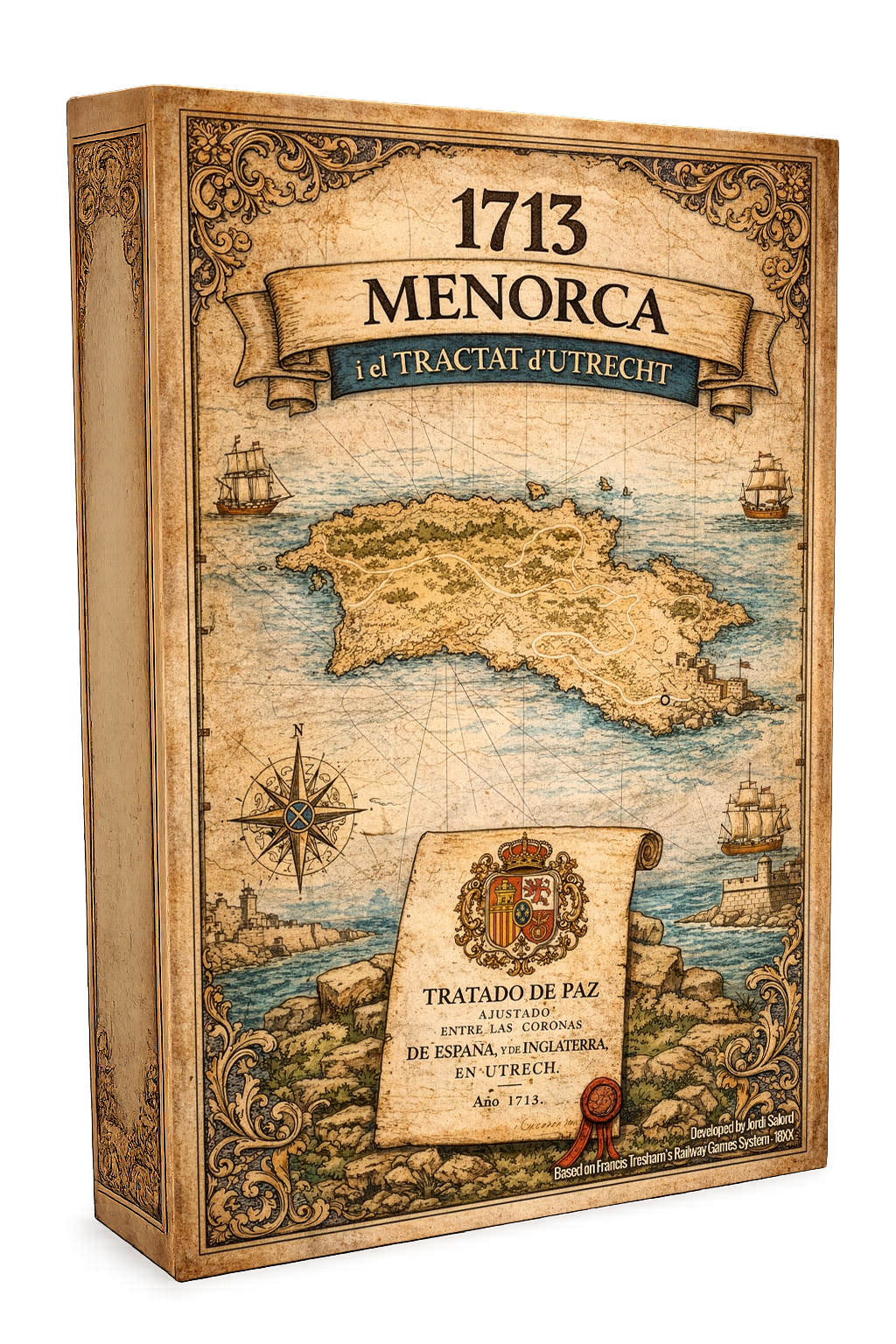
2–3 Players
2–3 h
14+
Game box image
Corporations

The Four Companies

RNC
Royal Navy Company
The British naval force. Dominates port routes and foreign trade. Mahón — island port centres
CLV
Compagnie du Levant
Connection to the Mediterranean Levant. Available from Phase 3. Mahón — eastern Mediterranean links
RCC
Real Compañía de Comercio
The Hispanic commercial legacy. Inland network and continental links. Ciudadela — island interior
RAM
Minorca Farmers and Artisans
The local Minorcan economy. Livestock, craftsmanship and inland trade. Alaior — inland rural network
Private Companies

Seven Exclusive Privates

In each game, 3 private companies are randomly selected from the 7 available. Each one grants unique abilities to its owner.

GSC
Ciudadela Shoemakers Guild

The old artisan guild of Ciudadela, with centuries of footwear-making tradition. Its network of suppliers and clients weaves together the island's western markets.

RAG
Es Grau Albufera Herds

The north-eastern coastal pastures feed herds that supply wool, meat and leather to inland markets. A discreet but solid business rooted in the territory.

LBI
Inland Livestock Levies

Large inland estates organise livestock movement through old paths that appear on no official map. An exclusive privilege of the Farmers.

IVR
Versailles Intelligence

A network of informants tied to French interests in the Mediterranean. Whoever controls it learns before anyone else where the political winds of the great powers are blowing.

CRB
British Royal Road

The main route crossing the island from Mahón to Ciudadela, built and maintained by the British administration. Whoever controls the road controls the flow of goods by land.

DRM
Royal Mahón Shipyards

The Mahón harbour shipyards work for the Royal Navy, but also build and repair merchant vessels. Holding their contract means privileged access to the island fleet.

CSF
Castle of San Felipe

The fortress commanding the entrance to Mahón harbour. Its military presence is the symbol of British power over the island and a powerful tool in skilled hands.

Merchant Fleet

Ships and Carts

Five nautical technology eras define game progress. Each new era can obsolete earlier vessels.

Type Name Obsolescence
V2 Xebec Rusts when V4 appears
V3 Galley Rusts when VE appears
V4 Frigate Never · permanent
VE Ship of the Line Never · permanent
C2 Cart Rusts in Phase 5
CM Goods Cart Never · permanent
Timeline

The Five Historical Eras

I
British Establishment 1713–1718
Game start · Xebec V2 · Cart C2
Corporations may buy private companies.
With the signing of the Treaty of Utrecht (1713), Minorca passes into British hands and is integrated into the Crown's naval strategy in the Mediterranean. Mahón harbour, deep and sheltered, immediately becomes a first-rate military base. Even so, initial economic activity remains limited. The island keeps traditional productive structures, and trade is still mainly Balearic and Peninsular in scope. At sea, traffic relies mostly on xebecs —light, agile vessels typical of the Mediterranean, ideal for cabotage— linking Minorca with Mallorca, Catalonia and other nearby points. It is a phase of establishment: the British consolidate control, but the economic system has not yet fully exploited the potential of Mahón harbour.
Xebec V2
II
Consolidation and Trade Expansion 1718–1735
Activates: first V3 ship · Galley V3 · Cart C2
Corporations may buy private companies. Marseille connection available.
Once British rule stabilises, Mahón begins to transform into an active commercial port. The British administration fosters a relatively open environment for international trade, attracting merchants of diverse origins: British, Catalan, Italian and French. Galleys, with greater capacity and autonomy than xebecs, expand the reach of trade. Products such as wool, leather and other island resources begin to integrate into broader commercial circuits. Opening links with ports such as Marseille reflects this expansion: Minorca ceases to be a closed system and starts taking an active role in international trade.
Galley V3
III
Mature Networks 1735–1745
Activates: first V4 ship · Frigate V4 · Goods Cart CM
Corporations may buy private companies. Xebecs are removed.
By the mid-18th century, the Minorcan economy enters a mature phase. Mahón harbour is no longer only a naval base, but a fully integrated commercial centre on Mediterranean routes. The introduction of frigates marks a qualitative leap. Fast and capable of defending themselves, they allow safer operation in an environment still shaped by corsair activity, and they support the creation of regular long-distance trade routes. Minorca is inserted into a network linking Marseille, Genoa and Barcelona. Trade stops being opportunistic and becomes structured, with steady flows of goods.
Frigate V4
IV
End of British Rule 1745–1756
Activates: first VE ship · Ship of the Line VE
Frigates are removed. Algiers connection available.
In the decades before 1756, Minorca reaches its highest level of economic development under British rule. Mahón harbour has consolidated itself as one of the most important enclaves in the western Mediterranean, both militarily and commercially. The appearance of large high-tonnage ships makes it possible to move much larger volumes of goods. Trade is no longer only regional or Mediterranean, but linked to wider circuits within the British Empire. Despite growing international tension, Minorca is now a consolidated commercial hub, with fully developed maritime and land networks.
Ship of the Line VE
The Board

Map of Minorca

The hex board recreates the geography of Minorca: harbours, roads, urban centres and the trade routes that connected the island to the Mediterranean during British rule.
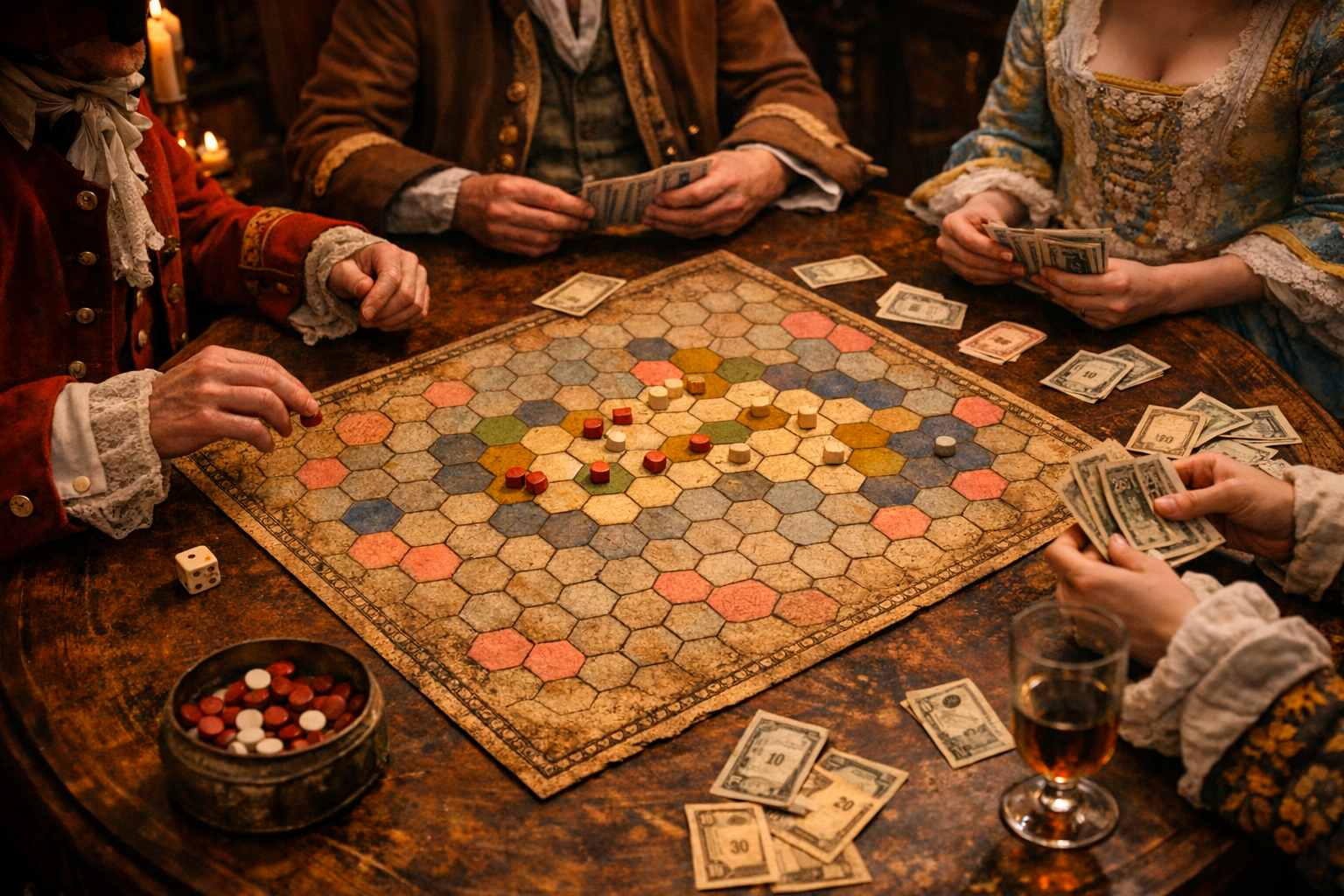
1713 Menorca hex map