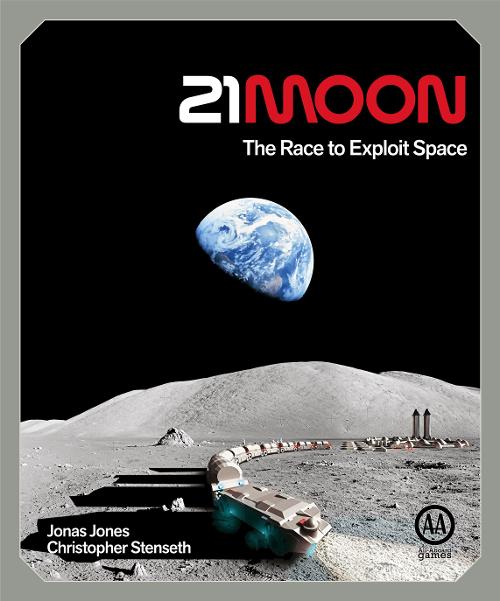
21Moon
Designer: Jonas Jones, Scott Petersen
Lunar mining in the year 2117, with temporary permits and an end-of-game fixed by the calendar.
21Moon: The Race to Exploit Space — Summary
Capitalization type
- Incremental capitalization: the treasury only receives the money actually paid for each share sold, both at IPO and in later issues.
- Corporations use their own separated-treasury model (treasury_as_holding): shares bought can go directly into the company's own cash instead of the pool.
Floating percentage and per-player share limits
- Floats once 50% of shares are sold (single threshold for every corporation)
- No player may hold more than 50% of a single corporation; with 2 players the cap rises to 60%
- Certificate limit per player: 2 players — 18; 3 players — 15; 4 players — 12; 5 players — 10
Starting cash by player count
- 2 players: ₡600 starting cash (60% ownership cap instead of the usual 50%)
- 3 players: ₡540 starting cash
- 4 players: ₡410 starting cash
- 5 players: ₡340 starting cash
- The bank always starts with ₡12,000
End game triggers
- A company goes bankrupt and only one solvent player remains: immediate end
- Fixed schedule: the game always ends when operating round 11 (OR 5.3) finishes, regardless of the bank or trains
Number of phases
- 6 phases (2, 3, 4, 5, 6, 10), triggered by the purchase of the first train of each type
- Every turn combines a stock round, a "corporate" round (buying/selling between corporations) and two operating rounds (three in the last one)
- The 7th corporation is held back and can't be founded until the 3rd stock round
Train list and prices
- T2 transport — ₡120 (5 units; obsolete on the first T5)
- T3 transport — ₡150 (4 units; obsolete on the first T6)
- T4 transport — ₡240 (3 units; obsolete on the first T10)
- T5 transport — ₡500 (2 units)
- T6 transport — ₡540 (2 units)
- T10 transport — ₡730 (unlimited)
- The progression jumps straight from T6 to T10, with no T7/T8/T9
List of private companies
- Old Landing Site (OLS) — ₡30 — places a black "SD" token on a mineral hex; can be sold to a corporation for just ₡1; gives rise to the OLS minor
- UN Contract (UNC) — ₡30, revenue ₡5 — when bought by a corporation, lets its president add or remove a 2-6 train from the depot; closes on use; resold for ₡1-₡45
- Space Bridge Company (SBC) — ₡40, revenue ₡10 — allows building across the Rift; ₡60 bonus once the connection is completed; resold for ₡1-₡60
- Research Lab (RL) — ₡60, revenue ₡10 — places a permanent +20 marker on a mineral or base hex; resold for ₡1-₡90
- Terminal (T) — ₡80, revenue ₡15 — teleports the terminal tile (X29) and places the cheapest base on it; resold for ₡1-₡120
- Tunnel Company (TC) — ₡100, revenue ₡15 — once per game, exchange for a free pool share; also gives corporations a discount to 10 on mountain terrain; resold for ₡1-₡150
List of corporations
- Shamsum Solar Farms (SSF) — home at D12
- Suijin Water Plants (SWP) — home at C7
- Hematite Low-G Mining and Quarry (HMQ) — home at D2
- Varuna Hydroculture (VH) — home at G7
- International Tritium Consortum (ITC) — home at I5
- Lunar Geodynamics (LG) — home at I11
- Kiviuq Rovertech (KR) — home at K9
- All float at 50% and have a 50% ownership cap (60% in 2-player games); one of the 7 is held back until the 3rd stock round
Game-specific mechanics
- Each hex's value depends on the mineral present (Source-X, Helium-3, Regolith, Armacolite, Magnetite); upgrading the tile changes the mineral's value, upward or downward depending on the type
- Every company must run trains from both its own home base (LB) and the shared Space Port (SP, hex E9); revenue is split between the two circuits
- ₡80 bonus for connecting the map's east and west exits on the same route; ₡30 bonus for reaching the terminal from the east
- End-game bonus tokens at the map's four corners (NE/SE/NW/SW), awarded when a company connects both sides; worth ₡50 per share in the final scoring
- The Space Port automatically upgrades (and rises in value) in operating rounds 3 and 5
Comparison with 1830
1. Setting: lunar mining in the year 2117
1830 covers the northeastern US in the 19th century. 21Moon moves the same game skeleton into the future:
companies don't transport passengers or classic goods, but instead mine critical minerals on the lunar surface
during the year 2117.
2. End of game by calendar, not by bank or by trains
In 1830 the game ends when the bank runs out or the last available train is bought. In 21Moon the end is set by
a strict deadline of 11 operating rounds in total, so there's no "dead queue" of passive turns waiting for
something to happen: the game always closes at the same point on the calendar.
3. Hex value depends on minerals, which change with each tile
In 1830 a hex's value comes from the city it contains and doesn't change in nature. In 21Moon, the minerals
present determine the hex's value, just like cities in classic 18xx games, but with a twist: when the tile
changes (when it's upgraded), the mineral's value also changes, and depending on the mineral type, that change
can be upward or downward.
4. Trains (transports) with their own progression: T2 to T6 and then T10
In 1830 trains follow a well-known 2-3-4-5-6-D progression. In 21Moon the "transports" go from T2 to T6 and
jump straight to T10, and on top of that, T2s become obsolete when T5s appear (not T4s, as the intuitive
equivalent would suggest) — a different obsolescence pace than you'd expect by analogy with 1830.
5. Two map "circuits": home base and shared Space Port
In 1830 all of a company's trains run through the same network connected to its own tokens. In 21Moon every
corporation must run trains from both its own home base and the shared Space Port (a single hex used by every
corporation), a dual-network structure with no equivalent in 1830.
6. Up to 7 corporations, with one held back until round 3
21Moon allows up to 7 simultaneous corporations mining the lunar surface, but one is deliberately locked out
until the third stock round. 1830 never withholds any of its companies this way.
7. Rules engine recognizable from 1830 and 1846
Despite the science-fiction setting, players experienced in 18xx usually quickly recognize how 21Moon works,
since its basic rules closely resemble those of 1830 and 1846: stock rounds, operating rounds, share and train
purchases.
8. A pure science-fiction theme, with no precedent in 1830
While 1830 recreates the real history of the North American railway boom, 21Moon invents a near future of
lunar resource exploitation, with no direct historical basis at all.