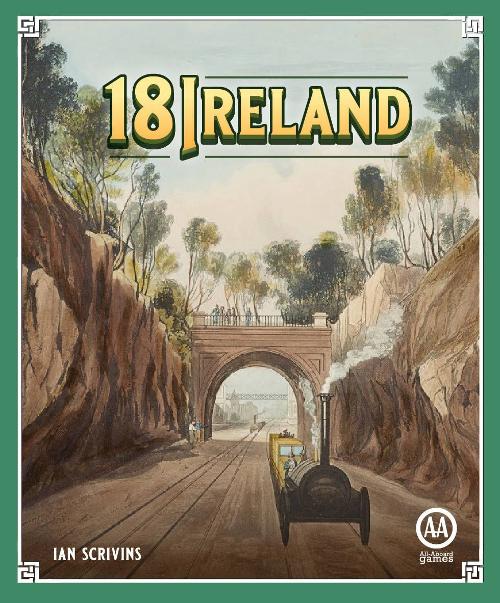
18Ireland
Designer: Ian Scrivins
5-share companies that merge (sometimes hostilely) into 10-share companies, with a small bank and two-stage train obsolescence.
18Ireland — Summary
Capitalization type
- Incremental capitalization: the company collects the par price each time one of its shares is actually sold.
Floating percentage and per-player share limits
- Major corporations float once 20% of shares are sold; minor railways float at 40%
- No player may hold more than 70% of a major corporation, or more than 60% (the default cap) of a minor
- Certificate limit per player: 3 players — 16; 4 players — 12; 5 players — 10; 6 players — 8
Starting cash by player count
- 3 players: £330 starting cash (certificate limit: 16)
- 4 players: £250 starting cash (certificate limit: 12)
- 5 players: £200 starting cash (certificate limit: 10)
- 6 players: £160 starting cash (certificate limit: 8)
- The bank starts with £4,000 (or £5,000 with the optional larger-bank variant)
End game triggers
- The bank runs out of money: the current full operating round set is finished
- A company goes bankrupt: immediate end
- A share price reaches the marked end-game space on the stock chart: the game ends once the current round is finished (no need to wait for the full operating round set)
Number of phases
- 6 phases (2, 4, 6, 8, 10, D), triggered by the purchase of the first train of each type
- Phase 4: private companies can now be bought in, and corporations can start merging with each other
- Phase 6: majors can now be founded directly via IPO, not only by merging minors
- Phase 8: minors can no longer be started, and all remaining privates close
- Phase 10: rusted trains can be traded in at face value for a more powerful train
Train list and prices
- 2H train — £80 (7 available; rusts once the first 6H train is bought)
- 1H' train — £40 (7 available, hidden until its counterpart rusts) — reduced version that replaces a rusted 2H; fully retired once the first 8H train is bought
- 4H train — £180 (5 available; rusts once the first 8H train is bought) — buying it enables mergers between corporations
- 2H' train — £90 (5 available, hidden until its counterpart rusts) — fully retired once the first 10H train is bought
- 6H train — £300 (4 available; rusts once the first 10H train is bought) — buying it enables founding majors directly via IPO
- 3H' train — £150 (4 available, hidden until its counterpart rusts) — fully retired once the first D train is bought
- 8H train — £440 (3 available) — buying it means minors can no longer be started, and all remaining privates close
- 10H train — £550 (2 available) — buying it enables trading in old trains at face value; discounted when trading in a 3H' or an 8H
- D train — £770 (unlimited) — the last available type; discounted when trading in a 3H', 8H, or 10H
- Train distance is measured in hex edges crossed (not stops), marked with an "H"
List of private companies
- 18Ireland defines 11, but only 5 are in play each game: Dalkey Atmospheric Railway and Dublin & Kingstown Railway are always included, plus 3 more chosen at random from the other 9
- Dalkey Atmospheric Railway (DAR) — £20, revenue £5 — blocks the Wicklow hex until bought or closed
- Donegal Railway (DR) — £30, revenue £7 — allows laying two connected narrow-gauge yellow tiles at Donegal and one adjacent hex; closes once used
- Board of Works (BoW) — £40, revenue £9 — allows laying a yellow tile without paying terrain costs, twice; closes after the second use
- City of Dublin Steam Packet Company (CDSPC) — £45, revenue £10 — adds a +£10 token to a port (Belfast, Londonderry, or Rosslare); closes once used
- Tralee & Dingle Railway (TDR) — £50, revenue £10 — allows laying two connected narrow-gauge yellow tiles at Tralee and Dingle; closes once used
- Drumglass Colliery Railway (DCR) — £60, revenue £12 — blocks hex H4 until bought or closed; the owner may lay a free yellow tile there
- Trans-Atlantic Steam Packet Station (TASPS) — £75, revenue £15 — adds a +£20 token to Galway; closes once used
- River Shannon Shipping Co (RSSC) — £80, revenue £10 — links Dromod and Limerick, adding the value of the other city to one train
- William Dargan Esq. (WDE) — £90, revenue £10 — allows a second tile upgrade per operating round, paying £30 from the treasury
- The Irish Mail (TIM) — £110, revenue £20 — allows placing an off-board hex near Londonderry, Kingstown, or Waterford; closes once used
- Dublin & Kingstown Railway (DK) — £120, revenue £0 — the owner takes the DKR presidency, sets its par price at half the winning bid, places a 2H train on its charter, and puts the rest of the bid into its treasury
List of corporations
- 7 majors (10 shares, float at 20%, ownership limit 70%): Great Southern & Western Railway (GSWR); Great Northern Railway Ireland (GNRI); Dublin & South Eastern Railway (DSER); Midland Great Western Railway (MGWR); Midland Railway North Counties Committee (MRNCC); Waterford, Limerick & Western Railway (WLWR); Cork, Bandon & South Coast Railway (CBSCR) — none has a fixed home: they're born by merging minors, or founded directly via IPO from phase 6 onward
- 14 possible minors (5 shares, float at 40%, ownership limit 60%; one is randomly removed at setup, except DKR): Londonderry & Enniskillen (LER) — G1; Cork, Blackrock & Passage Railway (CBPR) — E21; Enniskillen, Bundoran & Sligo Railway (EBSR) — F6; Sligo, Leitrim & Northern Counties Railway (SLNCR) — F6; Dublin & Drogheda Railway (DDR) — I11; Dublin & Kingstown Railway (DKR) — I11 (guaranteed to be in play); Grand Junction Railway (GJR) — D6; Ulster Railway (UR) — J4; Dundalk & Enniskillen Railway (DER) — I9; Great Northern & Western Railway (GNWR) — F10; Waterford & Kilkenny Railway (WKR) — G19; Central Ireland Railway (CIR) — G13; Kilkenny Junction Railway (KJR) — G13; Waterford & Limerick Railway (WLR) — D16
Game-specific mechanics
- Companies start with 5 shares and can merge (sometimes hostilely) to become a 10-share company, with a shareholder vote (even unowned bank pool shares count)
- Trains rust in two stages: they first become reduced (buyable back in a "hidden" version at half distance and half price), and are only fully retired later
- Distance measured in hex edges (not stops), with a separate narrow-gauge network that connects automatically without tokens and adds extra revenue
- Variable setup for both privates (5 of 11 possible) and minors (one is randomly removed, except DKR)
- Trading in old trains at face value for more powerful ones once phase 10 arrives
- Special bonus from the River Shannon Shipping Co linking Dromod and Limerick
Comparison with 1830
1. Companies start with only 5 shares, not 10
In 1830, every public company has 10 shares from the start. In 18Ireland there are up to 14 possible
companies with only 5 shares each (one always in play, another chosen at random); this smaller size is the
normal starting state for any company.
2. Mergers — sometimes hostile — to become a 10-share company
Two 5-share companies can merge to become one 10-share company. Shareholders of both companies vote for or
against it; even shares sitting in the bank pool "vote" based on whether the merger would raise or lower
their value. If the vote passes, the merger goes through even if one company's president doesn't want it. In
1830, public companies can never merge with each other.
3. Trains rust in two stages, not all at once
When a train becomes obsolete, it first "rusts": it can be bought back from the bank at half price but with
half its capability, and stays in play in that reduced state. Only later does it fully "rot" and get removed.
In 1830, an obsolete train is removed outright, with no such intermediate step.
4. Companies can permanently fall behind
The design accepts that some of the 13 starting 5-share companies simply won't thrive (due to
under-investment, geographic isolation, or poor founding timing) and will stay behind for the whole game,
rather than forcing every company to stay equally relevant the way 1830 tends to.
5. The bank pool's vote can decide a merger
Letting unowned shares in the bank pool "vote" on a merger based on the effect on their own value is a
mechanic with no equivalent in 1830, where pool shares are purely passive.
6. Irish setting with pounds sterling
The game is set in Ireland and uses pounds (£) as currency, reinforcing a historical identity quite different
from 1830's Northeastern USA.