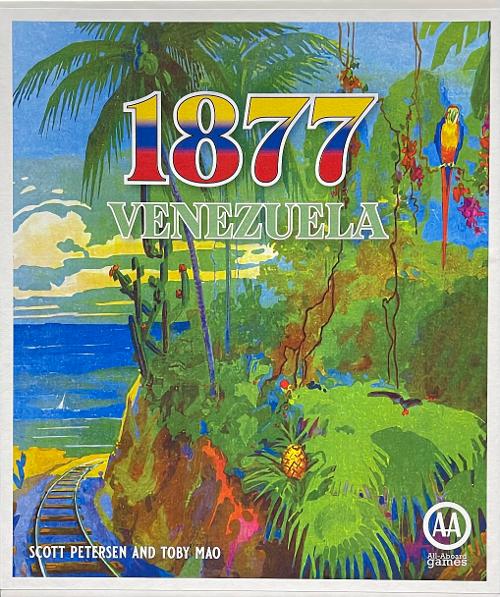
1877: Venezuela
Designer: Scott Petersen, Toby Mao
Venezuela in a 1817 compressed to 2-3 hours, with short selling, arbitrage and financial sabotage.
1877: Venezuela — Summary
Capitalization type
- Incremental capitalization (CAPITALIZATION = :incremental, inherited from the 1817 engine): when a player wins the auction to found a corporation, it immediately receives 2.5 times the share price in cash from the bank, while the other 3 shares (60% of the total) are placed directly on the market and the founder keeps the 40% certificate as president.
- The bank has unlimited money (BANK_CASH = :unlimited): there's no fixed fund that can run out.
Floating percentage and per-player share limits
- Floats once 20% of its shares are sold (same threshold for every corporation)
- No player may hold more than 60% of one corporation (default threshold, no exceptions)
- Certificate limit per player: 2 players — 21; 3 players — 16; 4 players — 13; 5 players — 11; 6 players — 9; 7 players — 9
Starting cash by player count
- 2 players: Bs.420 starting cash
- 3 players: Bs.315 starting cash
- 4 players: Bs.252 starting cash
- 5 players: Bs.210 starting cash
- 6 players: Bs.180 starting cash
- 7 players: Bs.142 starting cash
- The bank starts with unlimited money, regardless of the number of players
End game triggers
- A corporation goes bankrupt: immediate end of the game (rule inherited from 1817)
- The first type 4 train is bought or exported: the game reaches its final phase and one more full set of operating rounds is still played before it ends (final_phase: one_more_full_or_set)
Number of phases
- 4 phases (2, 2+, 3, 4), triggered by the purchase of the first train of each corresponding type
- Train limit per corporation: 4 during phases 2 / 2+ / 3, dropping to 3 in phase 4
- Available tile colors expand progressively: only yellow in phase 2, green is added in phase 3, and brown in phase 4
- Corporation size always stays at 5 (corporation_sizes: [5]): unlike 1817, there is no phase with 10-share corporations here
Train list and prices
- 2 train — Bs.100 (40 available; rusts when the first type 4 train is bought or exported)
- 2+ train — Bs.100 (3 available; same distance as the 2 train, but becomes obsolete —not rusted— when the type 4 train appears)
- 3 train — Bs.250 (10 available)
- 4 train — Bs.300 (unlimited; buying or exporting the first one triggers the end-game signal)
- Trains can only be bought from the bank, never from another corporation, unless the "Cross Train Purchases" optional rule is used
- Discarded trains are permanently removed from the game (DISCARDED_TRAINS = :remove) instead of returning to the available pool
List of private companies
- This game has no private companies: following the 1817 structure, there is no separate phase or auction for privates apart from the corporations themselves.
- Instead, each corporation is auctioned directly: the winning bidder founds and pars it immediately, and is also entitled to an immediate extra turn.
List of corporations
- Ferroviario de Barquisimento y Puerto Caballo (BPC)
- Ferroviario de Barinas y San Cristobál (BSC)
- Capital Line (Cap)
- Ferroviario de Caracas y La Guaira (CLG)
- Ferroviario de Encontrados y Machiques (E&M)
- Ferroviario de Caracas y Cúa (FCC)
- Ferroviario de La Encrucijada y San Juan de Los Morros (LESJ)
- Ferroviario de Machiques y Maracaibo (M&M)
- Ferroviario de Puerto Cabello y Barquisimeto (PCB)
- Ferroviario de San Juan de Los Morros y San Fernando de Apure (Sans)
- Ferroviario de Sabana de Mendoza y Barquisimeto (SMB)
- Tucucas Copper Mining Railway (TCM)
- No corporation has a fixed home on the map: the player who wins the founding auction freely chooses where to place the home token, unlike 1830 and 1846
Game-specific mechanics
- No private companies: every company is born as a public corporation through a direct auction
- Winning the founding auction grants an immediate extra turn to the winning player
- Incremental capitalization with a fixed bonus of 2.5x the share price and immediate placement of 60% of the shares on the market
- Trains can only be bought from the bank; discards are permanently removed from the game instead of returning to it (DISCARDED_TRAINS = :remove)
- Short selling and other financial tools inherited from 1817
- 60% ownership limit per corporation (max_ownership_percent: 60), same as 1830
- Certificate limit varies by player count: 21 (2p), 16 (3p), 13 (4p), 11 (5p), 9 (6p and 7p)
- Two mines randomly chosen from 11 possible hexes each game (the "No Mine Tiles" optional rule removes them)
- A game for 2-7 players; a prototype (PROTOTYPE = true) designed by Scott Petersen and Toby Mao as a direct variant of 1817 (DEPENDS_ON = '1817')
Comparison with 1830
1. Direct lineage with 1817, not with 1830
1877 isn't a direct variant of 1830: it inherits almost all of its DNA (corporation auctions, incremental
capitalization, short selling, absence of privates) from the 1817 engine (DEPENDS_ON = '1817'). Because of
this, this comparison is more of a contrast between two different design families than a comparison
between a direct parent and child.
2. There are no private companies
In 1830 the game begins with an auction of six private companies ($20 to $220) that provide revenue and
small perks throughout the game. Following the 1817 style, 1877 removes this phase entirely: every
corporation is born directly as a public company, auctioned off one at a time.
3. The founding auction rewards the winner with an extra turn
In 1830 the turn normally passes to the next player after founding a company. In 1877, the player who wins
the auction to found a corporation is entitled to act again immediately, a reward for the risk taken in
the bidding that doesn't exist in 1830.
4. Many small corporations with no fixed home, instead of a few large ones
1830 has 8 corporations of 10 shares each, all with a fixed home city on the map. 1877, in 1817 style, has
12, each with only 4 certificates (40/20/20/20) and no predetermined home: the founder chooses where to
place the home token. Both games, however, keep the same 60% ownership limit per shareholder.
5. A much wider player range, with much lower starting amounts
1830 supports 2 to 6 players, with $1,200/$800/$600/$480/$400 starting cash depending on player count.
1877 extends the range to 7 players (Bs.420/315/252/210/180/142 starting cash), with much smaller amounts
because the game's economic scale —and the cost of founding each small corporation— is also smaller.
6. Unlimited bank, and an end tied to the final phase rather than the bank running out
In 1830 the bank starts with a fixed $12,000 and the game usually ends when it runs out. In 1877 the bank
is unlimited; instead, the game ends when the first type 4 train is bought or exported, a much earlier and
more predictable trigger that lets the game wrap up in about 2-3 hours, much less than the 3-5 hours
typical of 1830.
7. Trains are only bought from the bank, and discards disappear forever
In 1830 a company can buy a used train from another company. In 1877 trains can only be bought new,
directly from the bank (unless the cross-train-purchase optional rule is used), and once discarded they're
permanently removed from the game instead of remaining available, which sharpens their scarcity.
8. 1817 financial tools absent from 1830
1877 incorporates short selling and other financial mechanisms typical of 1817, such as the direct bidding
used to found each corporation. None of these elements exist in 1830, where the game is simpler but also
less financially volatile.