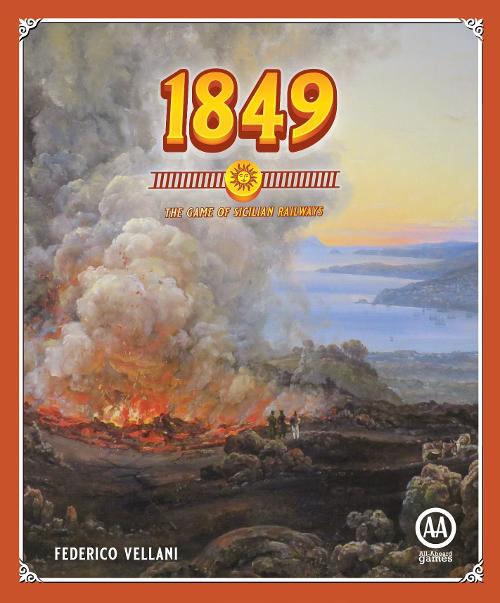
1849: The Game of Sicilian Railways
Designer: Federico Vellani
Sicily with three track gauges, terrain that always costs money, and trains that count hexes, not cities.
1849 Sicilian Railways — Summary
Capitalization type
- Incremental capitalization with no par value: when founded, the president buys the President's Share (20%) plus up to two more individual shares (40% total) in one block at market price, and all of that money goes to the treasury. From then on, the only way to raise more capital is by issuing shares later, never during the company's first operating round.
Floating percentage and per-player share limits
- Floats once 20% of shares are sold for every corporation
- No player may hold more than 60% (6 of 10 certificates) of a single corporation
- Certificate limit per player: 3 players — 12; 4 players — 11 (9 with the optional reduced-corporations- at-4-players rule); 5 players — 9
Starting cash by player count
- 3 players: L.500 starting cash
- 4 players: L.375 starting cash
- 5 players: L.300 starting cash
- The bank always starts with L.7,760, regardless of player count
End game triggers
- A player goes bankrupt: immediate end
- The bank runs out of money: the current full operating round set is finished
- A corporation reaches the highest space on the stock market (L.377): the game ends right after that corporation finishes operating (no need to wait for the rest of the set)
Number of phases
- 6 phases (4H, 6H, 8H, 10H, 12H, 16H), triggered by the purchase of the first train of each type
Train list and prices
- 4H train — L.100 (4 units; rusts once the first 8H-train is bought)
- 6H train — L.200 (3 or 4 units depending on player count; rusts once the first 10H-train is bought; unlocks parring at L.144)
- 8H train — L.350 (2 or 3 units depending on player count; rusts once the first 16H-train is bought)
- 10H train — L.550 (2 units; unlocks parring at L.216)
- 12H train — L.800 (1 unit; buying it closes the privates and triggers the Messina earthquake)
- 16H train — L.1,100 (4 or 5 units depending on player count)
- R6H train — L.350 (2 units, available from Phase 16H; a reduced version that only counts broad-gauge track)
- Every train counts hexes of track traveled, not cities visited
List of private companies
- SCE - Società Corriere Etnee — L.20, revenue 5, blocks Acireale (G13) while owned by a player
- SIGI - Studio di Ingegneria Giuseppe Incorpora — L.45, revenue 10, the owning corporation builds or upgrades at half cost on mountain, hill, or rough terrain (standard gauge)
- CNM - Compagnia Navale Mediterranea — L.75, revenue 15, the owning corporation may close it to place a permanent +L.20 marker on any port
- SMS - Società Marittima Siciliana — L.110, revenue 20, the owning corporation may close it to "teleport" to any coastal city instead of its normal tile and token steps, building and/or tokening there
- RSA - Reale Società d'Affari — L.150, revenue 25, cannot be sold to a corporation; comes with the first president's share of the associated corporation; closes when that corporation buys its first train (or otherwise at the start of Phase 12H)
List of corporations
- AFG - Azienda Ferroviaria Garibaldi — no fixed home; the president chooses on floating among Caltanissetta (H8), Messina (B14), Ragusa (M11), Terranova (M9), or Trapani (C1)
- ATA - Azienda Trasporti Archimede — home at M13
- CTL - Compagnia Trasporti Lilibeo — home at E1
- IFT - Impresa Ferroviaria Trinacria — home at H12
- RCS - Rete Centrale Sicula — home at C5
- SFA - Società Ferroviaria Akragas — home at J6
- With 3 players (or 4 with the matching optional rule), one corporation is randomly removed during game setup
Game-specific mechanics
- No par value: everything is bought and sold at the current market price
- A share's price only rises if the dividend paid is equal to or greater than its current market price
- Three track gauges: standard (black), narrow (hatched, terrain cost ÷4 but counts double in hexes), and dual/white (wildcard, adopts the type of the track it connects to)
- Terrain cost is always paid, even when upgrading an already-built tile
- The order in which corporations can float is determined randomly before the game begins
- Semi-restrictive tile upgrades: must add new track or improve the value of an already accessible city
- In the stock round, players sell first and then buy, with no alternating
Comparison with 1830
1. Setting and map
1830 covers the northeastern United States with a large map. 1849 takes place in Sicily, an island with a
more compact and mountainous map, where terrain (and three different track gauges) shapes every routing
decision far more than in 1830.
2. There is no par value
In 1830 each company starts at a par price chosen by its founder. In 1849 this concept doesn't exist: all
share trades always happen at the company's current market price, with no distinction between par price and
market price.
3. The share price only rises if the dividend is high enough
In 1830, every time a company pays a dividend, its price marker advances one space automatically. In 1849
this isn't automatic: the price only rises if the dividend paid per share is equal to or greater than the
share's current market price. If the payout is low relative to its price, the marker stays where it is.
4. Trains count hexes, not city revenue
In 1830, a train of a given size visits a set number of cities and adds up their revenue values. In 1849, a
"6H" train, for example, runs through any six hexes of track—whether there's a city there or it's plain
track—and the score depends on the route taken, not on how many stops "count." This completely changes how
an optimal network is designed.
5. Three track gauges, with a wildcard
There is no equivalent in 1830. In 1849 there are standard tracks (black), narrow tracks (hatched, which
cost a quarter of the usual terrain cost but count double for train length), and dual/white tracks, which
act as a wildcard: connected to a black track they count as standard, connected to a narrow one they count as
narrow.
6. Float order is randomly predetermined
In 1830, players freely decide which company to found and when. In 1849 there are six corporations, and the
order in which they can be founded is determined randomly before the game begins: only the first available
company in the queue can be floated, not whichever one a player wants. This distributes who gets access to
which company based on the buying order in the stock round.