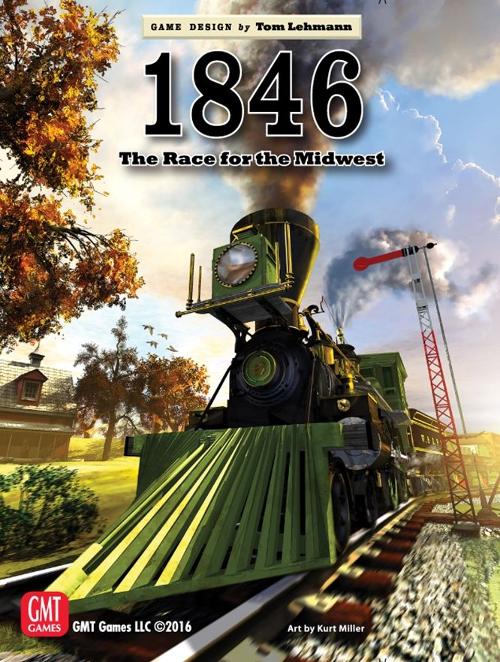
1846: The Race for the Midwest
Designer: Tom Lehmann
A fast entry point into 18xx set in the US Midwest, with incremental capitalization and drafted minors.
1846 The Race for the Midwest — Summary
Capitalization type
- Incremental capitalization: the company doesn't receive its full capital at once when it floats (unlike 1830); instead it collects the par price each time one of its shares is actually sold, both during the IPO and in later share issues.
Floating percentage and per-player share limits
- Floats once 20% of shares are sold for every major corporation (unlike 1830's 60%); the minors (Michigan Southern and Big 4) don't float at all, they start operational from the beginning
- No player may hold more than 60% (6 of 10 certificates) of a single major corporation, no exceptions
- Certificate limit per player (with the standard number of active corporations): 2 players — 19; 3 players — 14; 4 players — 12; 5 players — 11 (varies slightly depending on how many corporations are removed from the game under optional rules)
Starting cash by player count
- 2 players: $600 starting cash (bank has $7,000) — played with the dedicated 2-player variant
- 3 players: $400 starting cash (bank has $6,500)
- 4 players: $400 starting cash (bank has $7,500)
- 5 players: $400 starting cash (bank has $9,000)
End game triggers
- The bank runs out of money: the current full operating round set is finished
- The last 6-train is bought: one more full set of operating rounds is played, then the game ends
- A company goes bankrupt and only one solvent player remains: immediate end
- All companies close: immediate end (exceptional case)
Number of phases
- 4 phases (I, II, III, IV), triggered by the purchase of the first 4-train, 5-train and 6-train respectively
- Phase IV removes private company bonuses and any pending token reservations
Train list and prices
- 2 train — $80 (rusts once the 6-train appears)
- 4 train (or 3/5 variant) — $180 / $160 — buying it closes any privates still owned by players
- 5 train (or 4/6 variant) — $500 / $450
- 6 train (or 7/8 variant) — $800 / $900 — the last available type, permanent (never rusts)
- The quantity of each train type depends on the number of players
List of private companies
- Michigan Southern (minor) — $60 — floats with $60, a 2 train and a token in Detroit; always operates first
- Big 4 (minor) — $40 — floats with $40, a 2 train and a token in Indianapolis; operates right after the MS
- Chicago & Western Indiana — $60, revenue $10 — reserves an extra token slot in Chicago
- Mail Contract — $80, revenue $0 — adds $10 for each city visited by a train; never closes once owned by a corporation
- Tunnel Blasting Company — $60, revenue $20 — $20 discount when building on mountain/tunnel hexes
- Meat Packing Company — $60, revenue $15 — $30 bonus at St. Louis or Chicago
- Steamboat Company — $40, revenue $10 — bonus at a port city
- Lake Shore Line — $40, revenue $15 — extra free green tile upgrade at Cleveland or Toledo
- Michigan Central — $40, revenue $15 — up to two extra free yellow tiles at B10/B12
- Ohio & Indiana — $40, revenue $15 — up to two extra free yellow tiles at F14/F16
- Boomtown — $40, revenue $10 — $20 bonus at Cincinnati
- Little Miami — $40, revenue $15 — extra free connection between Cincinnati and Dayton
List of corporations
- Pennsylvania Railroad (PRR) — home at Ft. Wayne/F20
- New York Central Railroad (NYC) — home at D20
- Baltimore & Ohio Railroad (B&O) — home at G19
- Chesapeake & Ohio Railroad (C&O) — home at I15
- Erie Railroad (ERIE) — home at E21
- Grand Trunk Railway (GT) — home at B16
- Illinois Central Railroad (IC) — home at K3; receives an initial subsidy equal to its par price
- Michigan Southern (MS) and Big 4 (BIG4) — single-token "minor" companies, absorbable by the majors
Game-specific mechanics
- Map with river hexes placed differently each game
- "Minor" companies with an exchange round to absorb them
- Privates distributed by draft, with progressive $10 price drops
- Privates with active bonuses on specific routes, not just passive revenue
- Privates always sold at their exact face value
Comparison with 1830
1. Variable map, not fixed
1830 has a fixed map. In 1846, certain river hexes (Mississippi, Ohio) are placed randomly from a predefined
set each game, so the exact geography changes slightly each time.
2. Private auction by draft, not bidding
In 1830 privates go up for a classic auction with open bidding. In 1846 they're distributed through a draft
system: each player, in turn, takes a private (or a "blank" card) from an available selection; the last one
nobody wants drops $10 in price as it passes from player to player, until someone buys it or ends up
receiving it for free.
3. Privates can only be sold at face value
In 1830 a private can be sold to a company for up to double its face value, depending on negotiation. In
1846 a private can only be sold for its exact face value, with no room to negotiate upward.
4. Designed to be a shorter game
1846 is explicitly designed as a faster entry point into 18xx: a game typically wraps up in 2-3 hours,
noticeably less than a typical game of 1830.
5. A less "obvious" par price choice
In 1830 there's a clear tendency to found the first company at a low par price. In 1846 the design
explicitly aims to make the par price choice less of an obvious answer, forcing players to better weigh the
context of each specific game.
6. Minors with an exchange round, a concept 1830 doesn't have
1830 only has major companies, all founded and grown independently from scratch. 1846 includes a specific
phase where major companies can buy or absorb the remaining minors, incorporating their track and
treasury.