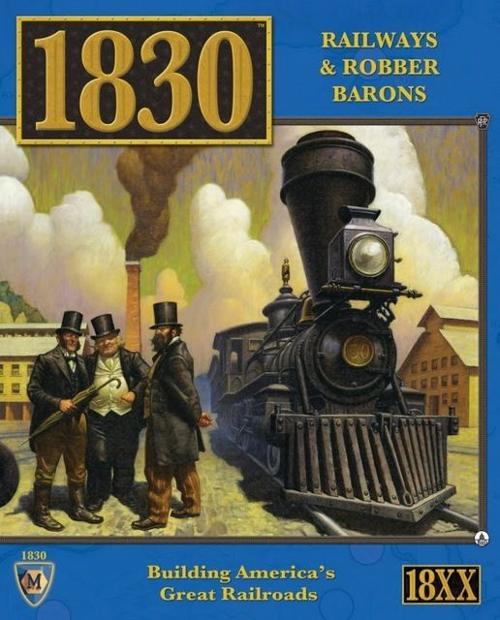
1830: Railways & Robber Barons
Designer: Francis Tresham
The classic reference 18xx: Northeastern USA, stock market, trains and bankruptcy.
1830 — Summary
Capitalization type
- Full capitalization: once it floats (60% sold), the company receives its entire capital (par price × 10) into the treasury at once.
Floating percentage and per-player share limits
- Floats once 60% of shares are sold (a single threshold for every corporation)
- No player may hold more than 60% (6 of 10 certificates) of a single corporation, no exceptions
- Certificate limit per player: 2 players — 28; 3 players — 20; 4 players — 16; 5 players — 13; 6 players — 11
Starting cash by player count
- 2 players: $1,200 starting cash
- 3 players: $800 starting cash
- 4 players: $600 starting cash
- 5 players: $480 starting cash
- 6 players: $400 starting cash
- The bank always starts with $12,000, regardless of player count
End game triggers
- The bank runs out of money: immediate end
- A company goes bankrupt and cannot complete payment for a mandatory train: immediate end
Number of phases
- 6 phases (2, 3, 4, 5, 6, D), triggered by the purchase of the first train of each type
Train list and prices
- 2 train — $80 (6 units; rusts with the first 4-train)
- 3 train — $180 (5 units; rusts with the first 6-train)
- 4 train — $300 (4 units; rusts with the first Diesel)
- 5 train — $450 (3 units; buying it closes the private companies)
- 6 train — $630 (2 units, or 3 with the optional 6-train rule)
- Diesel (D) — $1,100 (unlimited; allows trading in old trains at a discount)
List of private companies
- Schuylkill Valley (SV) — $20, revenue $5
- Champlain & St.Lawrence (C&StL) — $40, revenue $10
- Delaware & Hudson (D&H) — $70, revenue $15
- Mohawk & Hudson (M&H) — $110, revenue $20
- Camden & Amboy (C&A) — $160, revenue $25
- Baltimore & Ohio (B&O) — $220, revenue $30; whoever buys it also receives the B&O corporation's first presidential share
List of corporations
- Pennsylvania Railroad (PRR) — home at H12
- New York Central Railroad (NYC) — home at E19
- Canadian Pacific Railroad (CPR) — home at A19
- Baltimore & Ohio Railroad (B&O) — home at I15
- Chesapeake & Ohio Railroad (C&O) — home at F6
- Erie Railroad (ERIE) — home at E11
- New York, New Haven & Hartford Railroad (NYNH) — home at G19
- Boston & Maine Railroad (B&M) — home at E23
Game-specific mechanics
- Stock market with a fixed price grid, moved by dividend policy
- 60% (6-certificate) ownership limit per shareholder in any single company
- Up to three operating rounds in a row per stock round as the game progresses
- Bankruptcy falls on the president before the other shareholders
Comparison with 1829
1. 1830 is a refinement, not an independent game
1829 (Francis Tresham, 1974) is 1830's direct ancestor: Tresham himself co-designed 1830 twelve years later.
1830 doesn't invent the genre, it trims it down and turns it into the reference point.
2. A smaller map and player count
1829 covers southern England and Wales (with a Northern variant) and supports 2 to 9 players depending on
setup. 1830 narrowed this down to a single northeastern USA map for 2-6 players.
3. A single ruleset, with no complexity tiers
1829 ships with three levels of complexity (simple, intermediate, full) to bring new players in gradually.
1830 dropped this staged structure.
4. Standard track-laying, no "survey parties"
1829 required moving a survey token and only building in the hex it had just vacated. 1830 replaced this
with what's now the standard system: building in any hex connected to your own network.
5. A different train ladder and earlier rusting
1829 tops out at a 7-train (2/3/4/5/7 progression, no 6-train, no Diesel). 1830 rewrote this into the
2/3/4/5/6/Diesel progression that's now nearly universal in the genre, with rusting tied to its own 4-trains
and 6-trains.
6. A board-zone certificate limit, not a flat price threshold
1829 excludes shares priced below a flat threshold (£30) from the certificate limit. 1830 replaces this with
a specific zone of the stock chart (the yellow area).
Why 1830 is the genre's reference game
1. The reference game of the 18xx genre
1830 (Bill Dixon, Francis Tresham and Tom Lehmann, 1986) is the title that established the 18xx genre as we
know it today. Practically every other title in the series (1817, 1846, 1822, 18Chesapeake, etc.) is still
defined and explained today as a variation on this base game.
2. Setting, map and player count
The map covers the Northeastern United States, from Chicago to Boston and New York. It is designed for 2 to 6
players, with games typically lasting 3 to 5 hours depending on the group's experience.
3. Private companies and public companies
There are six private companies, auctioned off at the start of the game, which generate a fixed income each
operating round until they close (either bought out by a public company or when a certain train phase is
reached). Public companies each have 10 shares; the president must hold at least the double (president's)
certificate (20%) to found one.
4. Round structure: stock + operating rounds
Each game cycle alternates a stock round (buying and selling shares) with one or more operating rounds
(companies build track, buy trains and pay or withhold dividends). As the game progresses, up to three
operating rounds can follow each stock round.
5. Stock market and company share price
Each share's price moves along a fixed grid based on sales and dividend decisions: paying out 100% of profit
moves the price up, while withholding it (e.g. to pay for trains) moves it down. The share price directly
determines how much each certificate costs to buy or sell.
6. Trains and obsolescence (rusting)
Companies buy increasingly powerful trains (2, 3, 4, 5, 6 and Diesel) as the game progresses. Once a
sufficiently advanced train type is introduced, older trains "rust" (are removed from the game), forcing
companies still relying on them to upgrade their fleet or lose earning capacity.
7. 60% ownership limit per shareholder
No player may hold more than 60% (6 certificates) of a given public company's shares, except temporarily as a
result of the share pool. This necessarily spreads control of each company across several players.
8. Bankruptcy and limited liability of the company
If a company cannot afford a mandatory train and lacks the treasury for it, its president must cover the
shortfall with personal funds; if that's not enough either, the company can be liquidated. Bankruptcy mainly
affects the company and its president, not the other shareholders directly.
9. End of game
The game ends when the bank runs out of money (the bank pool is empty) or when the last available train of the
last type is bought, depending on the ending rule in use. All shares still held by players are then valued to
determine the winner.
10. Why it's the starting point of the genre
Almost every "new" mechanic found in other 18xx titles (loans, short selling, mergers, bigger or smaller maps,
modified stock markets) is presented and understood as an addition to, or removal from, this base ruleset from
1830.