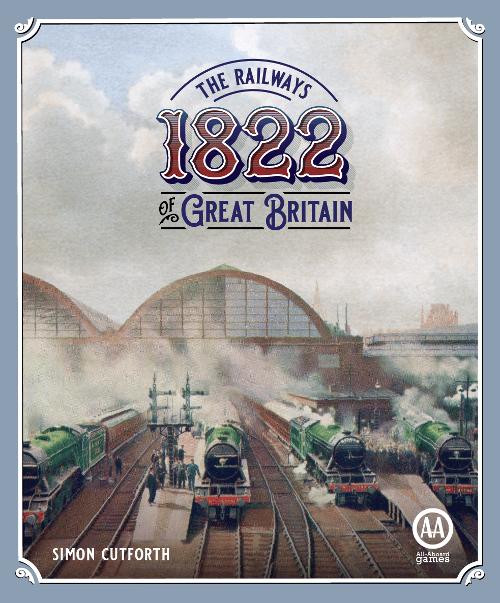
1822: The Railways of Great Britain
Designer: Simon Cutforth
The full 1822: all of Great Britain in constant auction of privates, minors, and major company concessions.
1822: The Railways of Great Britain — Summary
Capitalization type
- Incremental capitalization by default: the company collects the par price each time one of its shares is actually sold.
- Once the first 6-train is bought (phase 6), majors that float from then on switch to full capitalization (they receive all their capital at once; the remaining 5 treasury shares go straight to the market).
Starting cash by player count
- 2 players: £900 starting cash
- 3 players: £700 starting cash
- 4 players: £525 starting cash
- 5 players: £420 starting cash
- 6 players: £350 starting cash
- 7 players: £300 starting cash
- The bank always starts with £12,000, regardless of player count
End game triggers
- The bank runs out of money: the current full operating round set is finished (or the next operating round, if it happens during a stock round)
- A share price reaches the market cell marked "e" (700e): the game ends at the next end of an operating round
- If nobody sells a single share in the very first stock round: immediate end (an exceptional safeguard)
- Bankruptcy is disabled in this game (BANKRUPTCY_ALLOWED = false): it's not an end-game mechanism
Number of phases
- 7 phases (1 through 7), triggered by the purchase of the first train of each type
- Different train limits for minors and majors in each phase (for example, in phase 1: 2 for a minor, 4 for a major)
- Phase 2: concessions can be converted into major companies
- Phase 5: buying the first 5-train closes all unconverted concessions without compensation, and pending majors switch to floating at 50%
- Phase 6: buying the first 6-train gives majors that float from then on full capitalization
- Phase 7: buying the first 7-train closes privates P15 and P20 (phase-multiplied revenue) if they haven't been acquired yet
Train list and prices
- L train — £60 (22 units; rusts once the first 3-train is bought); can be converted into a "2" train for £80 before it rusts (own variant, distance 2, £120, available from phase 1, rusts once the first 4-train is bought)
- 3 train — £200 (9 units; rusts once the first 6-train is bought)
- 4 train — £300 (6 units; rusts once the first 7-train is bought)
- 5 train — £500 (3 units; buying it closes all pending concessions)
- 6 train — £600 (3 units; buying it triggers full capitalization for new majors)
- 7 train — £750 (unlimited; express variant "E", unlimited distance, ×2 multiplier, £1,000; buying it closes phase-revenue privates if not yet acquired)
- Special trains granted by privates (not bought on the market): 2P (permanent 2-train, free, 2 units), LP (permanent L-train, free, 1 unit), 5P (extra 5-train, £500, 1 unit), P+ (Pullman car that upgrades a train into a "+" train, free, 2 units)
List of private companies
- 21 privates (P1-P21), with no fixed price: they're won in a simultaneous auction using limited bidding tokens, not bought for a set starting price.
- P1 (a normal 5-train), P2 (removes a small station, closes when used), P3 and P4 (permanent 2-trains), P5 (free token in the English Channel), P6 and P7 (mail contracts, +50% of a train's station values), P8 (discount on hills/mountains, or a free rough-terrain token), P9 (declares double cash on hand for turn order, or variable revenue if owned by a company), P10 (discount and free tokens on rivers/estuaries), P11 (advances access to the next tile color), P12 (extra tile or additional upgrade), P13 and P14 (Pullman cars), P15 (revenue ×10 per phase, closes in phase 7), P16 (Tax Haven: can never be acquired, buys shares for the owning player without counting against the 60% limit), P17 (moves a card within the concessions/minors/privates stack), P18 (swaps an exchange token for an available one), P19 (permanent L-train, from phase 1), P20 (revenue ×5 per phase, closes in phase 7), P21 (free construction of the Grimsby-Hull bridge)
List of corporations
- 10 major companies (10 shares each), each founded by converting a "concession" (C1-C10) won at auction: London and North Western Railway (LNWR) — London/M38; Great Western Railway (GWR) — London/M38; London, Brighton and South Coast Railway (LBSCR) — London/M38; South Eastern & Chatham Railway (SECR) — London/M38; Caledonian Railway (CR) — Glasgow/E6; Midland Railway (MR) — J29; Lancashire & Yorkshire Railway (LYR) — G22; North British Railway (NBR) — Edinburgh/H5; South Wales Railway (SWR) — H33; North Eastern Railway (NER) — L19
- Up to 24 "minor" companies (M1-M24, and up to 30 with the 1822+ expansion), each a single-token 2-share company also won at auction and scattered across the whole map (Aberdeen, the Highlands, Edinburgh, Newcastle, Darlington, Barrow, Warrington, Sheffield, Grimsby, Birmingham, Peterborough, Ipswich, Maidstone, London, Southampton, Bournemouth, Cardiff, Pontypool, Merthyr Tydfil, Exeter, Cornwall, Swansea, Norwich, Hull, and with the expansion also Glasgow, Carlisle, Mid Wales and Plymouth). Minors can eventually merge into a major.
Game-specific mechanics
- Every stock round opens with a simultaneous auction of privates, minors, and major concessions, with limited bidding tokens per player that force you to choose which auctions to compete in
- A minor's par price isn't chosen by its founder: in phase 1 it's fixed (50); from phase 2 onward it comes from the winning bid (up to 200 treasury / 100 par)
- Minors can merge into a major (after operating at least once), bringing their already-built track along; payment can be in treasury shares and/or cash
- Stock round priority order is determined by how much cash each player has on hand, not a fixed turn order
- Initial "L" trains (a single station) convertible into 2-trains for £80 before they rust
Comparison with 1830
1. Setting and map
1830 covers the northeastern USA. 1822 takes place across all of Great Britain (England, Wales and Scotland),
with a very extensive map and a much denser network of cities, designed for games of up to 7 players.
2. Everything is bought at auction: privates, minors, and major "concessions"
In 1830 only the privates go up for initial auction; major companies are founded freely afterward. In 1822,
in every stock round, privates, "minor" companies (2 shares), and "concessions" to found major companies are
all auctioned simultaneously, with limited bidding tokens per player.
3. A minor's par price depends on the auction, it isn't chosen
In 1830 the founder freely chooses the par price. In 1822, in phase 1, a minor always starts at a fixed price
of 50, regardless of the winning bid. From phase 2 onward, the money from the winning bid goes into the
minor's treasury and sets its par price.
4. Minors merge into majors to create or grow them
This concept doesn't exist in 1830. In 1822, a minor must have operated at least once before it can be
absorbed by a major; payment to the minor's shareholder can be made with shares from the major's treasury
and/or cash. As a result, many majors are "born" by absorbing infrastructure already built by a minor.
5. Initial "L" trains and conversion to 2-trains
In 1830 the first generation of trains is already the normal 2-city train. In 1822 the game starts with
special "L" trains (a single station, cost £60) that can be converted into 2-trains for £80 before they
become obsolete. This initial step has no equivalent in 1830.
6. Priority order by cash on hand, not by turn order
In 1830 buying priority in the stock round passes cyclically to the left of the previous buyer. In 1822,
stock round priority order is determined by how much cash each player has, which rewards having spent heavily
in earlier auctions.
7. Many more companies in play simultaneously
Between privates, minors, and majors available for auction each round, 1822 supports far more active entities
at once than 1830, with a much more gradual and staggered pace of expansion.