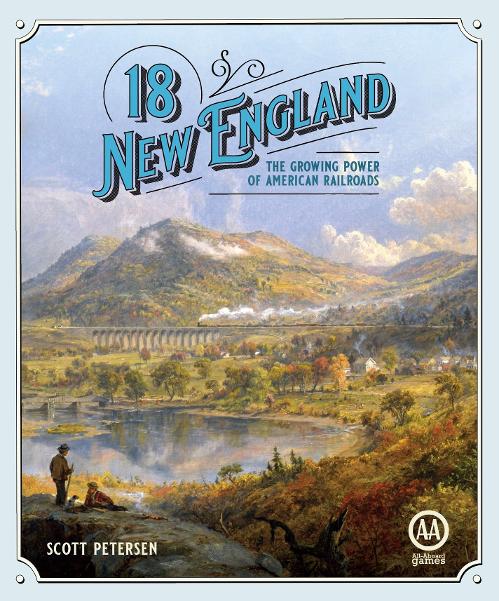
18NewEngland
Designer: Scott Petersen
From Massachusetts to New York: draft with no auctions, partial capitalization at par, and a great entry-level game.
18NewEngland — Summary
Capitalization type
- Two-tier system: the 15 "minor" companies each have a single share (100%) and incremental capitalization — they float instantly once someone buys their one share at a price chosen from a fixed grid. The 8 "major" companies use full capitalization (they receive par price × 10 all at once), but float with just 20% sold (2 shares), not 1830's usual 60%.
Floating percentage and per-player share limits
- Major corporations float once 20% of shares are sold; minors float at 100% (operating from the start)
- No player may hold more than 60% of a major corporation; minors have no cap (100%)
- Certificate limit per player: 3 players — 20; 4 players — 16; 5 players — 13
Starting cash by player count
- 3 players: $400 starting cash (certificate limit: 20)
- 4 players: $280 starting cash (certificate limit: 16)
- 5 players: $280 starting cash (certificate limit: 13)
- The bank always starts with $12,000, the same figure as 1830
End game triggers
- A share price reaches the marked end-game space on the stock chart: ends once the current round is finished (no need to wait for the full operating round set)
- A company goes bankrupt: immediate end
- The bank runs out of money: the current full operating round set is finished
Number of phases
- 6 phases (2, 3, 4, 5, 6, 8), triggered by the purchase of the first train of each type
- From phase 3 onward, every set of operating rounds is followed by a dedicated Merger Round, where players may combine minors into majors
- Minors' train limit drops from a maximum of 2 to just 1 starting in phase 4
Train list and prices
- 2 train — $100 (10 available; rusts once the first 4-train is bought)
- 3 train — $180 (7 available; rusts once the first 6E-train is bought)
- 4 train — $300 (4 available; rusts once the first 8E-train is bought)
- 5E train — $500 (4 available) — "express" train: ignores towns and, if a corporation owns more than one, the route's revenue is multiplied by the total number of express trains it owns
- 6E train — $600 (3 available) — same express and multiplier mechanic
- 8E train — $800 (unlimited) — the last available type, same express and multiplier mechanic
List of private companies
- 18NewEngland has no private companies at all. The game opens directly with a special round in which, in snake order, each player reserves and founds a "minor" company, choosing its par price from a fixed grid of yellow values (50/55/60/65/70) or, from phase 3 onward, also green values (80/90/100)
List of corporations
- 8 majors (no fixed home: they're born when players merge minors into them during a Merger Round): Boston and Albany Railroad (B&A); Boston and Maine Railroad (B&M); Canadian National Railroad (CN); Central Vermont Railroad (CVT); Delaware and Hudson Railroad (D&H); New York Central Railroad (NYC); New York, New Haven and Hartford Railroad (NYNHH); Providence and Worcester Railroad (P&W)
- 15 minors (a single 100% share each; 10 are randomly chosen to be available from the start, the rest unlock at phase 3): Albany and West Stockbridge (AWS) — B3; Boston and Lowell (BL) — L5; Boston & Providence (BP) — K10; Connecticut River (CR) — G8; Connecticut Valley (CV) — E2; Eastern Railroad (ER) — L5; Fitchburg Railroad (FRR) — J3; Granite Railway (GR) — L7; Hartford and New Haven (HNH) — F13; Hudson Railroad (HRR) — B3; New London Northern Railroad (NLN) — F13; New York New Haven Railroad (NYNH) — F13; New York Westchester Boston (NYW) — B19; Poughkeepsie and Eastern Railway (PE) — B11; Worcester, Nashua and Rochester Railroad (WNR) — I6
Game-specific mechanics
- No auction and no privates: the opening round is a snake-order reservation where each player directly picks which minor to found and at what par price
- Two-tier structure: minors (a single share, incremental capitalization) are the entry point; majors (10 shares, full capitalization, float at 20%) only come into existence when minors are merged into them during a dedicated Merger Round, available from phase 3 onward
- "Express" (E) trains: starting with the type-5 train, each additional express train a corporation owns multiplies its route's revenue by the total number of express trains it holds
- Separate treasury for each company (majors can issue or redeem their own shares from their treasury)
Comparison with 1830
1. Setting and map
1830 covers the northeastern USA with a large map and many cities. 18NewEngland is set in southern New
England, from Massachusetts down to New York, covering the routes of companies such as the New York, New
Haven & Hartford and the Boston & Maine. The map is more compact and the game is played with 3 to 5
players.
2. No auction and no privates: minors reserved in snake order
In 1830 privates go up for auction with open bidding. In 18NewEngland there are no privates and no auction:
the game opens with a snake-order reservation where each player directly picks which "minor" company to
found and at what par price, with no bidding mechanism or direct conflict.
3. Two-tier structure: single-share minors that merge into majors
In 1830 every company is equal from the start: 10 shares, full capitalization. In 18NewEngland there are two
clearly distinct company types: 15 possible "minors," each with a single share (100%), serving as the entry
point; and 8 "majors" with 10 shares, which have no fixed home and only come into existence when players
merge one or more minors into them during a dedicated Merger Round, available from phase 3 onward. This
"merging up" system has no equivalent in 1830.
4. Majors float with just 20% sold, not 60%
In 1830 a company needs 60% of its shares sold to float and receive capital. In 18NewEngland majors do so
with just 20% (2 shares), a much lower threshold that speeds up big companies' access to capital.
5. Express trains that multiply revenue instead of running separately
In 1830 each train a corporation owns runs its own route independently. In 18NewEngland, starting with the
type-5 train ("express," marked with an E), if a corporation owns more than one, instead of each running
separately, the route's revenue is multiplied by the total number of express trains it holds. It's a
revenue-stacking mechanism with no counterpart in 1830.
6. No privates in the base game
In 1830 privates are central to the opening phase: they generate revenue, trigger synergies, and set the
pace of the first stock round. In 18NewEngland the game does away with privates entirely: each player's
first action is directly reserving a minor and setting its par price, which greatly reduces initial
complexity.