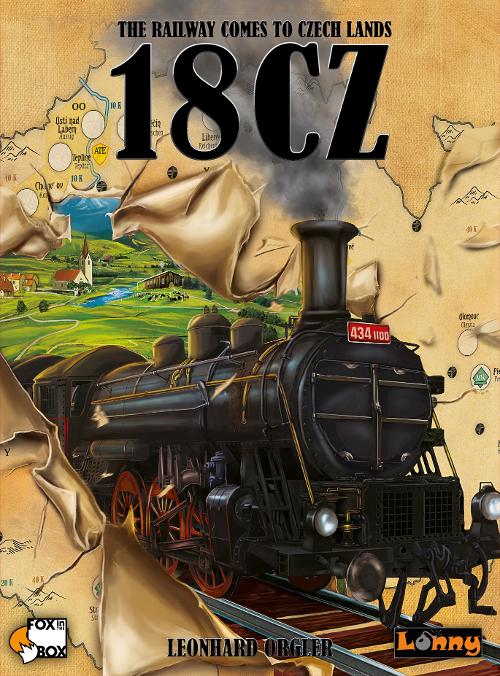
18CZ: The Railway Comes to Czech Lands
Designer: Leonhard "Lonny" Orgler
The Czech Lands with fifteen operating companies in three sizes (small, medium, big) that absorb one another, over a fixed run of eight stock rounds.
18CZ — Summary
Capitalization type
- Capitalization depends on company size: upon floating (50% sold, except medium companies which float at 60%), small companies receive 4 times the par price, medium companies 5 times, and only large companies get the usual 10 times seen in 1830.
Floating percentage and per-player share limits
- Floats at 50% of shares sold, except medium companies, which float at 60%
- No player may hold more than 60% (6 out of 10 certificates) of a large or medium company, but may hold up to 75% of a small company
- Certificate limit per player: 2 players — 14; 3 players — 14; 4 players — 12; 5 players — 10; 6 players — 9
Starting cash by player count
- 2 players: 280 K starting cash
- 3 players: 380 K starting cash
- 4 players: 300 K starting cash
- 5 players: 250 K starting cash
- 6 players: 210 K starting cash
- The bank is unlimited (no fixed amount of money)
End game triggers
- Fixed length by round: the "Local Railways Price" automatically rises by 5 K at the start of every operating round (from 40 to 120); once it reaches 120, that final operating round is played and the game ends, unrelated to the bank running out (which is unlimited anyway)
Number of phases
- 10 phases (a-j), triggered by the purchase of the first train of each type (2b, 3c, 3d, 4e, 4f, 5g, 5h, 5i, 5j)
- Medium companies unlock in phase b and large companies in phase d
- Green tiles unlock in phase d, brown in phase g, and gray in phase i
- The train limit per company progressively shrinks and varies by size (small/medium/large)
Train list and prices
- 2a train — 70 K (5 units; rusts with the 4e/4f/5g/5h/5i/5j trains) — exclusive to small companies
- 2b train — 70 K (4 units; same rusting) — buying it unlocks medium companies; "2+2b" variant for 80 K
- 3c train — 120 K (4 units; rusts with 5g/5h/5i/5j); "2+2c" variant for 80 K
- 3d train — 120 K (4 units; same rusting) — buying it unlocks large companies; "3+3d" (180 K) and Express "3Ed" (250 K) variants
- 4e train — 250 K (4 units); "3+3e" (180 K) and "3Ee" (250 K) variants
- 4f train — 250 K (4 units); "4+4f" (400 K) and Express "4Ef" (350 K, rusts with the 8Ej) variants
- 5g train — 350 K (4 units); "4+4g" (400 K) and "4Eg" (350 K, rusts with the 8Ej) variants
- 5h train — 350 K (2 units); "5+5h" (500 K) and "5Eh" (700 K) variants
- 5i train — 350 K (2 units); "5+5i" (500 K) and "6Ei" (800 K, rusts with the 8Ej) variants
- 5j train — 350 K, unlimited; "5+5j" (500 K) and the final Express "8Ej" (1,000 K) variants
- Three train families: "Normal" trains count exactly the locations visited; "Plus-trains" (X+X variants) have a total limit with a sub-cap on cities; "Express" trains (E variants) can pass through unlimited towns without them counting
List of private companies
- Regional Railways (S, small) — 5 K revenue each: S1 Plan-Tachau 25 K, S2 Melnik-Mscheno 30 K, S3 Zwittau-Politschka 35 K, S4 Wolframs-Teltsch 40 K, S5 Strakonitz-Blatna-Bresnitz 45 K, S6 Martinitz-Rochlitz 50 K — allow ignoring a river's building cost or laying a purple-edged green upgrade
- Main Railways (M, medium) — 10 K revenue each: M1 Raudnitz-Kmetnowes 40 K, M2 Schweißing-Haid 45 K, M3 Deutschbrod-Tischnowitz 50 K, M4 Troppau-Grätz 55 K, M5 Hannsdorf-Mährisch Altstadt 60 K, M6 Friedland-Bila 65 K — allow ignoring a river or hill's cost, or laying a purple-edged green/brown upgrade
- State Railway seeds (L, large) — 20 K revenue each: L1 Aujezd-Luhatschowitz 55 K, L2 Neuhaus-Wobratain 60 K, L3 Opočno-Dobruschka 65 K, L4 Wekelsdorf-Parschnitz-Trautenau 70 K, L5 Nezamislitz-Morkowitz 75 K, L6 Taus-Tachau 80 K — allow ignoring a river, hill, or mountain's cost
- All eighteen "Local Railways" are bought at a fixed price in a Pre-Stock Round; once in a player's hands, they can only be sold to a company (never to another player) starting once the first "b" train is bought, at a price between 1 K and the current "Local Railways Price"
List of corporations
- Large (State Railways, 20%+8×10%, 2 stations, all trains): Sächsische Eisenbahn (SX) — A8/B5; Preußische Eisenbahn (PR) — A22/B19; Bayrische Staatsbahn (BY) — F3/H5; kk Staatsbahn (kk) — J15/I18; Ungarische Staatsbahn (Ug) — G28/I24
- Medium (Main Railways, 40%-20%-20%-20%, 3 stations, small and medium trains): Böhmische Nordbahn (BN) — E12; Österreichische Nordwestbahn (NWB) — E12; Aussig-Teplitzer Eisenbahn (ATE) — B9; Buschtehrader Eisenbahn (BTE) — D3; Kaiser Ferdinands Nordbahn (KFN) — G20
- Small (Regional Railways, 50%-25%-25%, 3 stations, small trains only): Eisenbahn Karlsbad Johanngeorgenstadt (EKJ) — D5; Ostrau-Friedlander Eisenbahn (OFE) — C26; Böhmische Commercialbahn (BCB) — E16; Mährische Westbahn (MW) — F23; Vereinigte Böhmerwaldbahnen (VBW) — I10
Game-specific mechanics
- Three tiers of operating companies (small, medium, large), each with its own share denomination, number of stations, and allowed train family
- A Local Railway owned by a company grants a one-time special power, without stopping its regular income
- After running trains, a large company may fully acquire a smaller company if both directors agree, paying cash between 50% and 150% of the market price
- Obsolescence only affects trains of the same family/color: Normal trains don't rust Plus-trains or Express trains, and vice versa
- Emergency financing comes with a one-time 100% surcharge on the borrowed amount; until the debt is repaid, the player cannot buy shares in any subsequent stock round
Emergency sell
A sharp departure from 1830: presidents here can never be forced to sell personal shares. Order is treasury, then the president's personal cash, and if that's still not enough, an interest-free bank loan for the rest — but that loan comes back to bite at the very end, subtracted a second time from the player's final score. Corporations must also always hold a train here, not just when a route needs one, and can only ever buy from the bank, never from another corporation.
Comparison with 1830
1. Setting, map and number of players
1830 covers the northeastern USA for 2-6 players. 18CZ moves the action to the Czech lands (Bohemia,
Moravia, and Silesia), for 2-5 players in the base game, with additional variants for 2 players (the
"Bohemia" map) and 2-3 players (the "Moravia-Silesia" map).
2. Three tiers of operating companies, each with a different share denomination
In 1830 every company has exactly 10 shares of 10% each. In 18CZ there are three sizes: small companies or
Regional Railways (denomination 50%-25%-25%, small trains only, 3 stations), medium companies or Main
Railways (denomination 40%-20%-20%-20%, small and medium trains, 3 stations), and large companies or State
Railways (denomination 20%+8×10%, can use every train type, but only 2 stations).
3. Eighteen "Local Railways" bought at a fixed price, not through an auction
In 1830 the six privates are awarded through an ascending auction. In 18CZ there are eighteen Local
Railways (privates, six of each size) distributed in a Pre-Stock Round where each player simply buys one at
its stated fixed price or passes. Once in a player's hands, they can only be sold to a company (never to
another player) starting once the first "b" train is bought, at a price between 1 K and the current "Local
Railways Price."
4. Local Railways owned by a company grant a one-time special power
A function that doesn't exist in 1830. When a company owns a Local Railway, it may, on its turn, activate
its special power exactly once (lay an extra purple-edged tile, or ignore the terrain-building cost),
without this stopping its regular income.
5. A company can fully acquire a smaller one
In 1830 companies never merge with or absorb each other. In 18CZ, after running trains, a larger company
may acquire a smaller company outright if both directors agree, paying shareholders in cash a per-share
price between 50% and 150% of the market price and absorbing its treasury, trains, and stations.
6. Three distinct train families, each tied to a company size
In 1830 every train follows the same rule of counting cities and towns passed through. In 18CZ "Normal"
trains (for small companies) count exactly the revenue locations visited; "Plus-trains" (for medium
companies) have a total limit but with a sub-cap on cities; and "Express" trains (for large companies) can
freely skip as many towns as needed without them counting toward the total. On top of that, buying a new
train only scraps trains of the same family, so the three obsolescence tracks age independently of each
other.
7. Game length is fixed by a price track, not by the bank or the last train
In 1830 the game ends when the bank runs dry or the last available train is bought. In 18CZ the "Local
Railways Price" automatically rises by 5 K at the start of every operating round; once it reaches 120, that
final operating round is played and the game ends, regardless of how much money remains in the bank (which,
in fact, is unlimited).
8. Emergency financing is a one-time 100% surcharge, not liquidation
In 1830, if a company can't pay for a mandatory train, it can ultimately be liquidated. In 18CZ, if the
director doesn't have enough personal cash to cover the shortfall, they borrow from the bank with a one-time
100% surcharge on the borrowed amount (not recurring interest); until that debt (not the surcharge) is paid
off, the player cannot buy shares in any subsequent stock round.