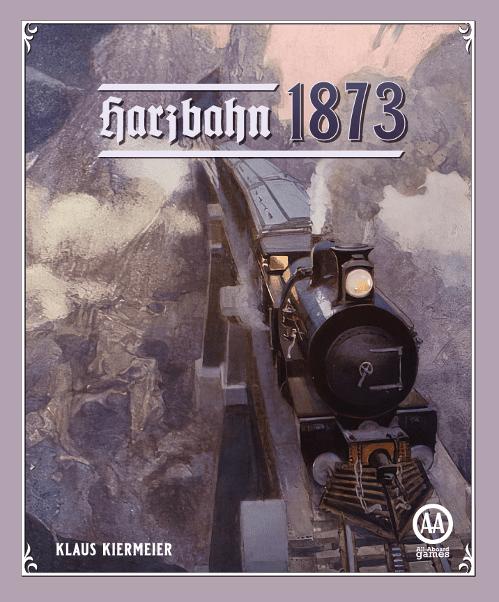
Harzbahn 1873
Designer: Klaus Kiermeier
Mines and railways in the Harz mountains, in a two-player classic with explicit technological progress.
Harzbahn 1873 — Summary
Capitalization type
- Incremental capitalization: the company doesn't receive its full capital at once when it floats; instead it collects the par price each time one of its shares is actually sold, both during the IPO and in later share issues.
Floating percentage and per-player share limits
- The 7 regional railways (HBE, GHE, NWE, SHE, KEZ, WBE, QLB) float at 60%; the 5 mining companies (U, HW, CO, SN, MO) float at 80%; the MHE (the large external company that appears later) starts already floated (0%)
- No corporation has a real per-player ownership limit: the threshold is 100% for all of them
- The certificate limit is effectively nonexistent: 999 regardless of player count (2 to 5)
Starting cash by player count
- 2 players: 2,100 ℳ starting cash
- 3 players: 1,400 ℳ starting cash
- 4 players: 1,050 ℳ starting cash
- 5 players: 840 ℳ starting cash
- The bank has unlimited money: the game never ends because the bank runs out of funds
- The certificate limit is effectively nonexistent (999, the same for any player count)
End game triggers
- A share price reaches the top of the stock market track: the current operating round is finished and the game ends
- Phase 5 is reached: one more full set of operating rounds is played before the game ends
Number of phases
- 7 phases: 1, 2, 3, 4, 5, 5a and D
- Phase 1 — no train trigger (train limit 99, 1 operating round, yellow tiles only); the HBE and GHE concessions are already available from the start
- Phase 2 — starts with the first 2T train; the NWE, SHE and KEZ concessions become available to activate
- Phase 3 — starts with the first 3T train (2 operating rounds, green tiles are added); the NWE, SHE and KEZ concessions become active; level 1 maintenance begins; buying this train removes certain track locks
- Phase 4 — starts with the first 4T train; the WBE and QLB concessions become active; maintenance rises to level 2
- Phase 5 — starts with the first 5T train (3 operating rounds, brown tiles are added); triggers the end of game countdown
- Phase 5a — a sub-phase with no new train triggering it; maintenance stays at level 2
- Phase D — starts once diesel trains become purchasable; gray tiles are added and maintenance rises to level 3 (the maximum)
Train list and prices
- 1T — 100 ℳ, distance 1, 2 available — starter/switcher train
- 2T — 250 ℳ, distance 2, 10 available (cheaper mine variant: 2M — 150 ℳ)
- 3T — 450 ℳ, distance 3, 7 available (variant 3M — 300 ℳ); buying it removes certain track locks
- 4T — 750 ℳ, distance 4, 3 available (variant 4M — 500 ℳ)
- 5T — 1,200 ℳ, distance 5, up to 99 available (variant 5M — 800 ℳ)
- D (diesel) — 250 ℳ, effectively unlimited distance, 7 available, only purchasable from phase 5a onward
- "T" trains are for railways, while the cheaper "M" trains (same distance) are the equivalent variant for mines
- Trains never rust in the classic 18xx sense: instead, railways pay rising maintenance on their built track, and diesel trains are managed through a trade-in pool system (high/low watermarks) rather than being replaced outright
List of private companies
- There are no classic private companies: the game's list of privates is empty.
- Instead, at the start of the game an auction (minimum bid 100 ℳ, increments of 10 ℳ) is held for a set of equivalent objects: each railway's concession (see the corporations section), the purchase option for each of the 5 public mining companies, and 15 individual minor mines (numbered 1 to 15, each tied to a specific map hex, valued between 110 ℳ and 300 ℳ) that can later be folded into a public mining company to generate machine and wagon revenue.
List of corporations
- Railways (float at 60%, 5 shares of 20% each; each carries a concession with a mandatory route to complete):
- Halberstadt-Blankenburger Eisenbahn (HBE) — home at B19/D15; concession available from phase 1, cost 0 ℳ
- Gernrode-Harzgeroder Eisenbahn (GHE) — home at G20/I18; concession from phase 1, cost 150 ℳ
- Nordhausen-Wernigeroder Eisenbahn (NWE) — home at J7/B9/G6; concession from phase 3, cost 500 ℳ
- Südharzeisenbahn (SHE) — home at I2/E4; concession from phase 3, cost 300 ℳ
- Kleinbahn Ellrich-Zorge (KEZ) — home at I4/G4; concession from phase 3, cost 100 ℳ
- Wernigerode-Blankenburger Eisenbahn (WBE) — home at B9/D15; concession from phase 4, cost 0 ℳ
- Quedlinburger Lokalbahn (QLB) — home at E20; concession from phase 4, cost 0 ℳ, with no mandatory route (already considered "complete")
- Mines (float at 80%, 2 shares of 50% each, no home token; operate mine slots instead of track):
- Union (U)
- Harzer Werke (HW) — flagged "vor_harzer" (a special status, likely a historic priority mine)
- Concordia (CO)
- Schachtbau (SN)
- Montania (MO)
- External entity:
- Magdeburg-Halberstädter Eisenbahn (MHE) — floats at 0%, 10 shares of 10%, no tokens; represents an outside railway that connects to the map but is neither founded nor operated like the others; it exists purely as a market-price reference
Game-specific mechanics
- No classic private companies: each railway's concession and the rights to the individual mines are distributed through an auction/draft at the start of the game
- Each railway must complete its concession route by a set phase, or it is left "incomplete" and penalized
- Individual mines can be folded into a public mining company, which operates machines and wagons (bought as "M" trains) to generate revenue from ore extraction rather than from railway routes
- Maintenance system: railways pay upkeep on their built track, and this cost rises through levels (1, 2 and 3) as the phases advance, adding an ongoing economic pressure distinct from classic train obsolescence
- Diesel trains are managed through a trade-in pool (high watermark 40, low watermark 20) instead of rusting
- The map distinguishes narrow-gauge track sections from standard-gauge sections
- Optional "AAG" variant that changes the terrain cost of hex F7 (100 ℳ instead of 50 ℳ)
Comparison with 1830
1. Full capitalization versus incremental
In 1830 a company receives its entire capital at once when founded (full capitalization). In Harzbahn 1873
capitalization is incremental: each share pays the par price only when it is actually sold, both during the
IPO and in later share issues.
2. No classic private companies: concessions and mines up for auction
1830 has 6 classic private companies auctioned at the start of the game. Harzbahn 1873 has none at all:
instead, at the start of the game each railway's concession and the rights to a set of individual mines are
auctioned off.
3. Three company sizes versus a uniform size
In 1830 all 8 corporations have 10 shares. In Harzbahn 1873, 7 railways with 5 shares of 20% each coexist with
5 mining companies of 2 shares of 50% each and an external market entity (MHE) with 10 shares of 10%.
4. Founding a company requires completing a mandatory route
In 1830 founding a corporation only requires buying its first share at the chosen par price. In Harzbahn 1873,
each railway carries a concession that obliges it to complete a predefined route by a specific phase, on pain
of being left "incomplete" and penalized.
5. Rising maintenance and a diesel pool instead of rusting
In 1830 trains rust outright once a more advanced type appears. In Harzbahn 1873 trains never rust in that
sense: railways pay maintenance on their built track that rises through levels as the phases advance, and
diesel trains are managed through a trade-in pool system rather than being replaced outright.
6. Phases also unlock which concessions can be founded
In 1830 phases only affect which tile colors are available and the train limit. In Harzbahn 1873, phases also
unlock which railway concessions can be activated (HBE and GHE from phase 1, NWE/SHE/KEZ from phase 3,
WBE/QLB from phase 4).
7. Scale and setting: a small, regional narrow-gauge game
1830 recreates the northeastern United States with large corporations across a sprawling map. Harzbahn 1873
is a small, regional design for 2-5 players, set among the narrow-gauge railways of the Harz mountains in
Germany.