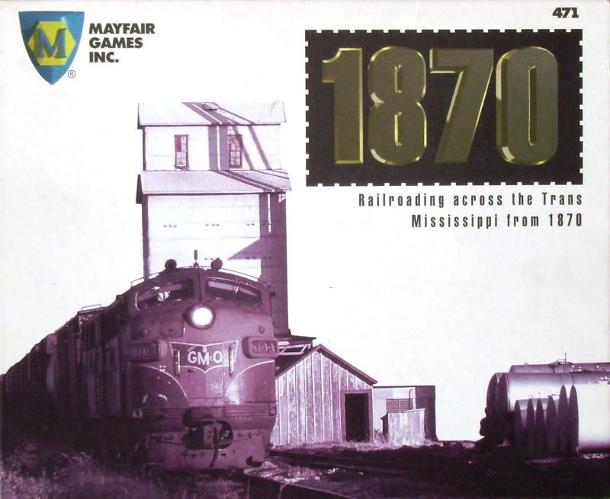
1870: Railroading Across the Trans Mississippi from 1870
Designer: Bill Dixon
The Trans-Mississippi with a huge map and the richest stock-market game in the whole 18xx family.
1870 — Summary
Capitalization type
- Full capitalization: when it floats (60% of shares sold, except the Frisco which floats with only 20%), the company receives its entire capital in the treasury at once, the same as in 1830.
Floating percentage and per-player share limits
- Floats once 60% of its shares are sold (same threshold for every corporation), except the Frisco (SLSF), which may operate with just 20% sold
- No player may hold more than 60% of one corporation (default threshold, no exceptions)
- Certificate limit per player (varies depending on whether the game uses the 9- or 10-corporation variant): 2 players — 28/24; 3 players — 20/17; 4 players — 16/14; 5 players — 13/11; 6 players — 11/9; 7 players — 9/7
Starting cash by player count
- 2 players: $1,050 starting cash
- 3 players: $700 starting cash
- 4 players: $525 starting cash
- 5 players: $420 starting cash
- 6 players: $350 starting cash
- 7 players: $300 starting cash
- The bank always starts with $12,000, regardless of player count (1870 supports up to 7 players, one more than 1830)
End game triggers
- A company goes bankrupt: immediate end
- The bank runs out of money: the current full operating round set is finished before the game ends
- With the "$400 Finish" optional rule: the game ends immediately the moment any corporation's stock hits $400 on the market grid, with no further operations played
Number of phases
- 8 phases (1 through 8) under the standard rules, triggered by the purchase of the first 3, 4, 5, 6, 8, 10 and 12 train respectively
- Each company's train limit and the number of operating rounds per stock round increase as the game progresses (up to 3 consecutive ORs from phase 4 onward)
- With the "Diesels variant" optional rule the game is reduced to 6 phases (1 through 5 and D), with Diesels replacing the 8, 10 and 12 trains
Train list and prices
- 2 train — $80 (7 available; rusts once the first 4-train is bought)
- 3 train — $180 (6 available; rusts once the first 6-train is bought; buying it makes private companies buyable by corporations)
- 4 train — $300 (5 available; rusts once the first 8-train is bought)
- 5 train — $450 (4 available; rusts once the first 12-train is bought; buying it closes any privates still owned by players)
- 6 train — $630 (3 available; never rusts; buying it removes private company tokens from the board)
- 8 train — $800 (3 available)
- 10 train — $950 (2 available)
- 12 train — $1,100 (unlimited, the last available type)
- With the "Diesels variant" optional rule, the 4-train rusts on the Diesel (D) instead of the 8-train, the 5-train never rusts, and the Diesel ($1,100, unlimited, available from phase 5) replaces the 8, 10 and 12 trains, allowing 4/5/6 trains to be exchanged for it at a $300 discount each
List of private companies
- Great River Shipping Company (GRSC) — $20, revenue $5 — no special abilities
- Mississippi River Bridge Company (MRBC) — $40, revenue $10 — until it is closed or sold, no company may bridge the Mississippi River; the purchasing corporation gets a $40 discount building on a hex along the river; only the Missouri Pacific or the St.Louis Southwestern may buy it during phase 1, for $20 to $40, and if they do so during their first OR they get an extra free tile lay at their home city
- The Southern Cattle Company (SCC) — $50, revenue $10 — token placeable on any city west of the Mississippi, adding $10 to that city's value for the owning company only; placing it does not close the private
- The Gulf Shipping Company (GSC) — $80, revenue $15 — two port tokens (open and closed) placeable at one of five Gulf cities; the open token adds $20 for the owner and $10 for everyone else; the closed token adds $20 for the owner only and closes the company when placed
- St.Louis-San Francisco Railway (SLSF) — $140, revenue $0 — president's certificate of the SLSF corporation; the buyer sets the par price and can float it with just 20% sold; it cannot be sold to another corporation
- Missouri-Kansas-Texas Railroad (MKT) — $160, revenue $20 — comes with a 10% share of the MKT corporation
List of corporations
- Santa Fe (ATSF) — home at B9, floats at 60%, destination N1
- Cotton (SSW) — home at H17, floats at 60%, destination J3
- Southern Pacific (SP) — home at N1, floats at 60%, destination N17
- Frisco (SLSF) — home at E12, floats with just 20% (tied to the SLSF private), destination M22; cannot be bought by another corporation
- Missouri Pacific (MP) — home at C18, floats at 60%, destination J5
- Katy (MKT) — home at B11, floats at 60%, destination N1
- Illinois Central (IC) — home at K16, floats at 60%, destination A22
- Gulf Mobile Ohio (GMO) — home at M20, floats at 60%, destination C18
- Fort Worth (FW) — home at J3, floats at 60%, destination A2
- Texas Pacific (TP) — home at J5, floats at 60%, destination N17
Game-specific mechanics
- Destination bonuses: each corporation has an assigned destination hex; connecting it to its home city earns extra revenue, and some trains must include this home-to-destination route
- Price protection: under certain circumstances in a stock round, a player can "protect" a corporation's share price so it doesn't drop (or drops less) when shares are sold
- Share redemption: a corporation with enough treasury cash can buy back its own shares from the market (or from players, if none are available on the market), paying cash at the current market price
- Reissue of treasury shares at a discount of up to 25% off the market price (capped at $200 with the "Maximum reissue $200" optional rule)
- The certificate limit depends both on the number of players and on the number of corporations actually in play (10 or 9): for example, 28 certificates for 2 players with 10 corporations, or 24 with 9 corporations
- No company may bridge the Mississippi River while the Mississippi River Bridge Company private is still active, unless bought by the Missouri Pacific or the St.Louis Southwestern
- A wide range of optional rules: from "$400 Finish" (immediate game end once a stock hits $400) to a full Diesels variant, plus a "Bill Dixon's original rules" bundle that combines several of these variants at once
Comparison with 1830
1. Same full capitalization, much larger scale
1870 uses the same full capitalization system as 1830 and shares the same bank size ($12,000), but does so on
a huge map west of the Mississippi, designed so that nearly every company that manages to float can end up
being profitable, instead of the more competitive, resource-constrained scenario of 1830.
2. Ten corporations and six privates, for up to 7 players
1870 has ten public companies (two more than 1830's eight) and six privates, with more room for parallel
expansion without constantly clashing with rivals. It also supports up to 7 players, one more than 1830's
maximum of 6.
3. Share price protection
A mechanic that doesn't exist in 1830: 1870 includes "price protection" rules that cushion a company's market
value from dropping under certain circumstances, making stock management somewhat less harsh than in 1830.
4. Discounted reissue of treasury shares
When a company reissues its own treasury shares in 1870, it can do so at a discount of up to 25% off the
current market price. In 1830, issuing new shares (when possible) is always done at market price, with no
such built-in discount.
5. Destination bonuses for every corporation
1870 rewards companies that connect to their assigned destination city with a bonus unique to the game, a
directed-expansion incentive that 1830 lacks (1830 has no destinations assigned to companies).
6. Privates with their own money-generating abilities
Beyond a fixed revenue stream as in 1830, some privates in 1870 (like the Southern Cattle Company or the Gulf
Shipping Company) have special abilities to generate extra income for their owner under certain game
circumstances, adding an extra layer of personal optimization on top of running companies.
7. Same stock market design lineage, with extra layers
Bill Dixon, 1870's sole designer, was also a co-designer of 1830 (together with Tresham and Lehmann) and of
its stock market. 1870 inherits that same price grid but adds price protection, redemption and discounted
reissue on top, making it one of the 18xx family's titles best known for the depth of its stock market
game.
8. A much wider range of optional rules
1870 ships with an unusually large set of optional rules (Diesels variant, $400 finish, station marker wars,
original tiles, reissue capped at $200, original market, and a full "Bill Dixon's original rules" bundle that
combines several of these at once), a configuration flexibility that 1830 doesn't offer.