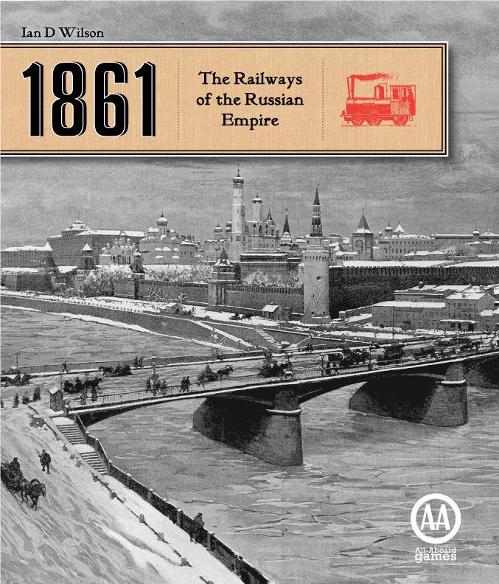
1861: The Railways of the Russian Empire
Designer: Ian D. Wilson
The Russian Empire, with minors that grow into majors and a state railway that can absorb them.
1861 — Summary
Capitalization type
- Incremental capitalization: each company collects the par price only for the shares that are actually sold, both during the IPO and in later share issues, rather than receiving its full capital at once when it floats.
Floating percentage and per-player share limits
- Floats once 20% of shares are sold for the 8 major corporations; the minors (single-share companies such as RO, KB, OK, KK, SPW, MB, KR, N, etc.) float at 100%
- No player may hold more than 60% (the standard threshold) of a major corporation; for minors, since they only have a single 100% share, the cap is 100%
- Certificate limit per player: 2 players — 21; 3 players — 21; 4 players — 16; 5 players — 13; 6 players — 11
Starting cash by player count
- 2 players: 420₽ starting cash
- 3 players: 420₽ starting cash
- 4 players: 315₽ starting cash
- 5 players: 252₽ starting cash
- 6 players: 210₽ starting cash
- The bank always starts with 15,000₽, regardless of player count
End game triggers
- The bank runs out of money: only the current operating round is finished (not the whole set)
- The first 8-train is bought: one more full set of operating rounds is played; this final set is extended to three operating rounds (with slightly different timing if the 8-train appears in the very first OR of the set)
Number of phases
- 7 phases (2, 3, 4, 5, 6, 7, 8), each triggered by the purchase of the first train of that number
- Tile color progression: yellow → yellow+green → +brown (phase 5) → +gray (phase 6)
- Train limits vary by entity type and tighten over the game: majors go from 4 trains (phase 3) down to 2 (phases 6-8); minors go from 2 down to 1 train after phase 3; the National (RSR) always has an effectively unlimited limit (99)
- From phase 4 onward the "national_operates" status kicks in: the National Railway starts operating (and withholding or buying trains) after the minors and majors have done so each round
Train list and prices
- Trains pay based on cities/off-map exits visited: towns are visited for free, with no limit
- 2 train — 100₽ (10 available); rusts once the first 4-train is bought
- 3 train — 225₽ (7 available); rusts once the first 6-train is bought; triggers green minors becoming available
- 4 train — 350₽ (4 available); rusts once the first 8-train is bought; triggers majors becoming foundable, and sets up trainless-nationalization checks
- 5 train — 550₽ (4 available); never rusts; triggers minors no longer being foundable
- 6 train — 650₽ (2 available); never rusts; nationalizes any private companies still in player hands, and triggers trainless-nationalization checks
- 7 train — 800₽ (2 available); never rusts
- 8 train — 1,000₽ (unlimited supply); never rusts; nationalizes all remaining minors (absorbed into the National), and triggers trainless-nationalization checks
- 2+2 train — 600₽ (unlimited, only available once phase 8 is reached) — counts as two 2-trains (multiplier 2)
- 5+5E train — 1,500₽ (unlimited, only available once phase 8 is reached) — an "express" double train (multiplier 2); on its first leg it only pays on off-map exits
List of private companies
- A hidden "3" company (value 3₽) isn't a purchasable private: it simply blocks five hexes (E3, H6, I5, I9, J10) until phase 3 begins
- Tsarskoye Selo Railway (TSR) — 30₽, revenue 10₽ — no special ability
- Black Sea Shipping Company (BSS) — 45₽, revenue 15₽ — when owned by a corporation, +10₽ on any route through Odessa (D20)
- Moscow – Yaroslavl Railway (MYR) — 60₽, revenue 20₽ — when owned by a corporation, +10₽ on any route through Moscow (H8)
- Moscow – Ryazan Railway (MRR) — 75₽, revenue 25₽ — when owned by a corporation, +10₽ on any route through Moscow (H8)
- Warsaw – Vienna Railway (WVR) — 90₽, revenue 30₽ — when owned by a corporation, +10₽ on any route through the Poland hexes (A9/A11/A13/A15)
List of corporations
- Majors (float at 20%, 3 token slots, freely choose their home city): North Western Railway (NW), Southwestern Railway (SW), Southeastern Railway (SE), Moscow, Vindava & Rybinsk Railway (MVR), Moscow & Kazan Railway (MK), Grand Russian Railway (GRR), Moscow, Kursk & Nizhnii Novgorod (MKN), Moscow, Kiev & Voronezh Railway (MKV)
- Minors (float at 100%, a single share, a single token, fixed home): Riga-Orel Railway (RO) — B4; Kiev-Brest Railway (KB) — D14; Odessa-Kiev Railway (OK) — D20; Kiev-Kursk Railway (KK) — D14; St. Petersburg Warsaw (SPW) — E1; Moscow-Brest Railway (MB) — E9; Kharkiv-Rostov Railway (KR) — G15; Nikolaev Railway (N) — H8; Yuzovka Railway (Y) — H18; Moscow-Kursk Railway (M-K) — H8; Moscow-Nizhnii Novgorod (MNN) — H8; Moscow-Voronezh Railway (MV) — I13; Vladikavkaz Railway (V) — I19; Tsaritsyn-Riga Railway (TR) — K17; Samara-Vyazma Railway (SV) — N10; Ekaterinin Railway (E) — Q3
- National: Russian State Railway (RSR) — home at St. Petersburg (E1), 8 token slots, shares hidden and not normally tradable; operated each round by whichever player currently holds priority deal, starting from phase 4
Game-specific mechanics
- Two-tier company system: 16 small single-token minors that float fully from the start, and 8 majors that can only be started once the first 4-train is bought, growing over time into full 10-share companies
- The National Railway (RSR) belongs to no player: each operating round it's run by whoever currently holds priority deal; it starts operating once phase 4 is reached
- Loan system: corporations can take out loans of 50₽ each, up to a per-type maximum, paying 5% interest each operating round, to help afford trains
- Progressive nationalization tied to train purchases: privates are nationalized on the first 6-train, remaining minors are nationalized on the first 8-train, and any minor or major left operating without a train is also nationalized ("trainless nationalization")
- An optional Column (1D) stock market can be used instead of the default Grid (2D) one
Comparison with 1830
1. Capitalization
1830 uses full capitalization: the company receives its entire capital at once when it floats. 1861 uses
incremental capitalization: it only collects the par price for the shares actually sold, gradually.
2. Two-tier company system
1830 has 8 fixed majors of 10 shares each, all available from the start with a fixed home city. 1861 has 25:
16 small single-token minors that float fully right away, and 8 majors that can't be founded until the first
4-train appears, which choose their own home freely and grow into full companies over time.
3. The National Railway
A company that belongs to no player; instead, whoever holds priority deal operates it each round. 1830 has
no equivalent — every company has real shareholders from start to finish.
4. Nationalization tied to trains
In 1861, buying certain trains triggers the state to "nationalize" (absorb) first the privates (6-train) and
later the remaining minors (8-train), plus any company left without a train. In 1830, trains only cause
equipment to rust — never the absorption of an entire company.
5. Loans
1861 lets corporations take out loans of 50₽ each (up to a cap depending on company type) and pay 5%
interest each round to help afford expensive trains. 1830 has no loan mechanism at all — each company relies
solely on its own treasury.
6. Setting and map
1861 takes place in the Russian Empire, with a very extensive map and off-map exits toward peripheral
regions. 1830 has a fixed, more compact map of the northeastern US.
7. Design lineage
1861 shares its engine and design philosophy with 1867: Railways of Canada, both by Ian D. Wilson. 1830
(Dixon, Tresham and Lehmann), by contrast, is the original design from which most other 18xx games
descend.