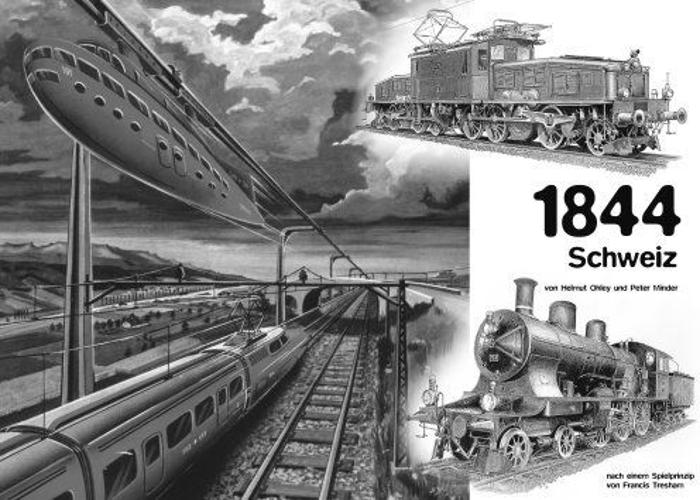
1844: Schweiz
Designer: Helmut Ohley
Switzerland with mountain railways, tunnel-building companies, and two clearly distinct generations of locomotives.
1844 — Summary
Capitalization type
- Split into two halves, not classic full or incremental: the Large Historical Companies (H1-H6) and the Pre-SBB companies (V1-V5) only receive half their capital when floating (5 times the par price for Historical companies, 2 times for Pre-SBB companies); the other half only arrives once the company connects its home hex to the destination hex marked on its charter.
- Regional companies (R1-R3), which have no destination, receive their full capital at once when floating (5 times the par price, 100% of their value).
Floating percentage and per-player share limits
- The Pre-SBB (V1-V5) and Historical (H1-H6) companies float at 50% of shares sold; the Regionals (R1-R3)
float at 60%; the SBB (formed by merger at the end of the game) has its threshold set at 20%, but with
floatable: false, since it never floats through a classic share purchase - No player may hold more than 60% of a single corporation, except the Pre-SBB (V1-V5), where the limit rises to 75%
- Certificate limit per player: 3 players — 24; 4 players — 18; 5 players — 15; 6 players — 13; 7 players — 11
Starting cash by player count
- 3 players: 800 SFR starting cash
- 4 players: 620 SFR starting cash
- 5 players: 510 SFR starting cash
- 6 players: 440 SFR starting cash
- 7 players: 400 SFR starting cash
- The bank always starts with 12,000 SFR, regardless of player count
End game triggers
- The bank runs out of money: the current full operating round set is finished
- 1844's rules explicitly remove bankruptcy: a director without enough company treasury or personal cash to complete a mandatory purchase doesn't liquidate the company; instead they go into debt to the bank, paying 50% interest on the outstanding debt every stock round until it's cleared
Number of phases
- 7 phases (1 through 7), triggered by the purchase of the first 2, 3, 4, 5, 6 and 8E train respectively
Train list and prices
- 2 train — 90 SFR (13 units; 2H variant at 70 SFR; rusts once the first 4-train is bought)
- 3 train — 180 SFR (9 units; 3H variant at 150 SFR; rusts once the first 6-train is bought)
- 4 train — 300 SFR (6 units; 4H variant at 260 SFR; rusts once the first 8E-train is bought)
- 5 train — 450 SFR (6 units; 5H variant at 400 SFR; buying it closes the privates and triggers the merger of the Pre-SBB companies into the SBB; never rusts)
- 6 train — 630 SFR (4 units; 6H variant at 550 SFR; never rusts)
- 8E train — 960 SFR (20 units; 8H variant at 700 SFR; pays for its 8 best stops; never rusts)
- Every train type exists in a normal version (counts cities) and a cheaper H version (counts hexes traversed); older trains get "downgraded" to the H version before eventually fully rusting
List of private companies
- P1 - Brienzer-Rothorn-Bahn — 20 SFR, revenue 5, no special ability
- P2 - Bödelibahn — 50 SFR, revenue 10, once per game allows laying an extra yellow tile
- P3 - Gotthard-Postkutsche — 80 SFR, revenue 15, comes bundled with Tunnel Company T1
- P4 - Furka-Oberalpbahn — 110 SFR, revenue 20, allows placing a free special tile; doing so closes it and the owner receives 80 SFR compensation (mandatory by the time the first 5/5H train arrives)
- P5 - Compagnie Montreaux-Montbovon — 140 SFR, revenue 25, comes with a 10% share of the MOB
- P6 - Societa anonima delle ferrovie — 180 SFR, revenue 30, comes with the FNM's director's share; the buyer sets the FNM's par price and it floats instantly; closes when the FNM runs its first train
- P7 - Lokfabrik Oerlikon — 100 SFR, revenue 0, closes when the first 5/5H train is bought and the owner receives the "EVA" (5H) train for free, assignable to any corporation they direct
- B1-B5 - Mountain Railways — 150 SFR each, bought outright (no auction) during stock rounds; place a marker on a mountain hex and pay 40 SFR per round once a corporation runs a train there; never close and don't count against the certificate limit
- T1-T5 - Tunnel Companies — 50 SFR each; grant a one-time right to build a tunnel for 100 SFR (a +10 SFR bonus per stop once used); never close and don't count against the certificate limit
List of corporations
- NOB - Schweizerische Nordostbahn (V1, Pre-SBB) — home at D19, destination D15
- SCB - Schweizerische Centralbahn (V2, Pre-SBB) — home at C12, destination F17
- VSB - Vereinigte Schweizer Bahnen (V3, Pre-SBB) — home at C24, destination F25
- JS - Jura-Simplon (V4, Pre-SBB) — home at I4, destination F7
- GB - Gotthardbahn (V5, Pre-SBB) — home at G18, destination H19
- JN - Jura Neuchatelois (R1, Regional) — home at F7
- ChA - Chur-Arosa (R2, Regional) — home at G28
- VZ - Visp-Zermatt (R3, Regional) — home at K10
- FNM - Ferrovie Nord Milano (H1, Historical) — home at L21, destination G20
- RhB - Rhätische Bahn (H2, Historical) — home at G26, destination J13
- BLS - Bern-Lötschberg-Simplon (H3, Historical) — home at F11, destination J13
- STB - Sensetalbahn (H4, Historical) — home at D15, destination H13
- AB - Appenzeller Bahn (H5, Historical) — home at D25, destination C20
- MOB - Montreux-Oberland Bernois (H6, Historical) — home at I6, destination H13
- SBB - Schweizer Bundesbahnen — starts with no home of its own; formed by merging the five Pre-SBB companies
Game-specific mechanics
- Three tiers of companies (Pre-SBB, Regional, Historical) with different share structures and rules
- Trains with a dual version: normal (cities) and H (hexes)
- Mountain Railways and Tunnel Companies as direct special investments, outside of the corporations
- Mandatory merger of the five Pre-SBB companies into the SBB once the first 5/5H train arrives
- No bankruptcy: replaced by debt carrying 50% interest per stock round
- The bank automatically "exports" the cheapest train at the end of every block of operating rounds
- Regional companies' share price is capped at 200 SFR
Emergency sell
Starts the same way as 1830 — company treasury, then the president's or owner's personal cash — but adds a bank loan as an alternative to forced share sales rather than a last resort after them: the player can borrow to cover the shortfall without first having to sell anything. It also blocks one 1830 quirk: a forced sale here can never change the presidency of another corporation the seller holds shares in, something 1830 allows to happen incidentally.
Comparison with 1830
1. Setting, map and number of players
1830 covers the northeastern USA for 2-6 players. 1844 moves the action to Switzerland, with a map dominated
by mountains and tunnels, and is designed for large groups of 3 to 7 players.
2. Three tiers of operating companies with different rules from each other
In 1830 every company follows exactly the same rules. In 1844 there are three types, each reflecting a
different stage of real Swiss railway building: the small Pre-SBB companies destined to merge away, the
limited Regionals, and the Large Historical Companies that dominate the long game.
3. The destination hex turns building into a race with a goal, not just revenue generation
In 1830 laying track only matters for generating higher revenue. In 1844, physically reaching a company's
destination hex is a goal in itself, since it unlocks the second half of its capital: this forces routes to be
planned around a specific point on the map, not just the most profitable city.
4. Trains that count by hexes, not just cities, reflecting the mountainous geography
In 1830 a train's route is always counted by the number of cities and towns it passes through. In 1844 the
cheaper H version of every train counts each hex traversed instead: on a map full of mountains and tunnels,
this gives spreading through difficult terrain a value of its own, not just connecting big cities.
5. Mandatory merger of five companies into the Swiss State Railway (SBB)
In 1830 companies never merge with each other. In 1844 the five Pre-SBB companies mandatorily merge into the
SBB the moment the first 5 or 5H train is bought, echoing the real nationalization of Swiss railways: the SBB
receives all the Pre-SBB companies' possessions at once.
6. There is no bankruptcy: debts accrue interest instead of triggering liquidation
In 1830, if a company can't pay for a mandatory train, it can ultimately be liquidated. 1844 removes that risk
of elimination: an indebted director simply pays growing interest until they dig their way out, which
considerably softens the game's punishment/randomness component.