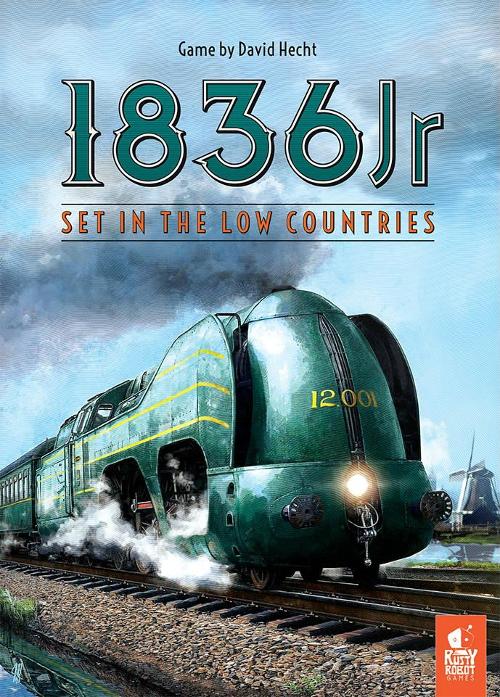
1836Jr56
Designer: David Hecht
The same short, kid-friendly 18xx, this time built from 1856's components.
1836Jr56 — Summary
Capitalization type
- Three-stage capitalization, just like 1856: companies float with only 20% sold, with the rest of the capital held in "escrow." Once the third 4-train is bought, new companies switch to incremental capitalization (collecting money as each share actually sells). Once the second 5-train is bought, they switch to full capitalization (100% at once, as in 1830). A company still in escrow that connects its home to its assigned "destination" hex releases its escrow early.
Floating percentage and per-player share limits
- Floats once 60% of shares are sold (a single threshold for all corporations), though this threshold interacts with the game's own three-stage capitalization (see "Capitalization type" above)
- No player may hold more than 60% (6 of 10 certificates) of a single corporation, no exceptions
- Certificate limit per player: 2 players — 20; 3 players — 13; 4 players — 10
Starting cash by player count
- 2 players: 450 F starting cash
- 3 players: 300 F starting cash
- 4 players: 225 F starting cash
- The bank always starts with 6,000 F, regardless of the number of players
End game triggers
- The bank runs out of money: the current full operating round set is finished, then the game stops
- A company goes bankrupt and can't complete payment for a mandatory train: immediate end
- Nationalization (the MESS being born) doesn't end the game by itself: it's only triggered by the purchase of the first 6-train
Number of phases
- 6 phases in total (2, 3, 4, 5, 6, then either 8 by default or D with the optional Diesel rule), triggered by the purchase of the first train of each type
- Each phase also determines the current capitalization stage and whether loans are still available (they get cut off once phase 6 arrives)
Train list and prices
- 2 train — 100 F (5 copies; rusts on the first 4-train)
- 3 train — 225 F (4 copies; rusts on the first 6-train)
- 4 train — 350 F (3 copies; rusts on the first 8-train, or the first Diesel if the "Diesel variant" optional rule is used)
- 5 train — 550 F (2 copies; buying it closes the private companies)
- 6 train — 700 F (2 copies; the first one bought triggers nationalization and removes tokens from the map)
- 8 train — 1,000 F (5 copies, available from phase 6; allows trading in old trains for a 350 F discount each) — the default final train
- Diesel (D) — 1,100 F (practically unlimited, 22 copies; same 350 F discount per old train) — replaces the 8-train only if the "Diesel variant" optional rule is activated
List of private companies
- Amsterdam Canal Company (ACC) — 20 F, revenue 5 F — no special ability; blocks hex D6 while owned by a player
- Enkhuizen-Stavoren Ferry (E-SF) — 40 F, revenue 10 F — lets its owner lay a free tile on hex B8, in addition to the normal tile lay for the turn
- Charbonnages du Hainaut (CdH) — 50 F, revenue 10 F — lets its owner lay a tile and station token on hex J8 for just the mountain terrain cost, with no connection to the existing network required
- Régie des Postes (RdP) — 70 F, revenue 15 F — lets its owning company place a "+20" marker on any city or town: from then on, every time one of that company's trains passes through it, the location is worth 20 F more, forever
- All privates close, at the latest, once the first 5-train is bought
List of corporations
- Chemins de Fer de l'État Belge (B) — home at H6
- Grande Compagnie du Luxembourg (GCL) — home at I9
- Chemin de Fer du Nord (Nord) — home at I3
- Noord-Brabantsch-Duitsche Spoorweg-Maatschappij (NBDS) — home at E11
- Hollandsche IJzeren Spoorweg Maatschappij (HSM) — home at D6
- Noord-Friesche Locaal (NFL) — home at A9
- Maatschappij tot Exploitie van de Staats-Spoorwegen (MESS) — doesn't exist at the start of the game: it's born once the first 6-train is bought, formed from leftover shares of other companies; it has no home of its own, an effectively unlimited train limit, and can borrow an 8-train or Diesel whenever it's left without a train
Game-specific mechanics
- Corporate loans of 100 F each, at 10% interest per loan; the maximum number of simultaneous loans a company can hold equals its number of shares held by players; available up through phase 6, at which point any outstanding loans must be repaid
- Nationalization: buying the first 6-train removes tokens from the map and spins up the MESS, absorbing leftover shares from other companies
- Destinations: each regular company has an assigned destination hex; connecting its network there while still in escrow immediately releases all of its held capital
- Fixed certificate limit (20/13/10 depending on whether there are 2, 3, or 4 players), never recalculated after nationalization
- Ports (Harwich, Dover, Paris) that pay no revenue of their own: they add +20 F (green phase) or +30 F (brown phase) to a route with at least two other stops
Emergency sell
Essentially the 1830 baseline, with one restriction borrowed from 1856: a corporation forced to buy a train can only buy it from the bank, never from another company's holdings. Otherwise the sequence is unchanged — treasury, then the president's personal cash, then a forced sale of the president's shares in any corporation, exempt from the normal restrictions, with bankruptcy as the backstop.
Comparison with 1830
1. Built on 1856's engine, not 1830's
1830 covers the northeastern USA for 2-6 players. 1836Jr56 shares the same Netherlands-and-Belgium map as its
sibling 1836Jr30 and the same 2-4 player range, but instead of being built on 1830's system, it's literally
built on 1856's rules engine: staged capitalization, loans and nationalization are all present from the
start, none of which happens in its 1830-based twin.
2. Three-stage capitalization, not full from the start
In 1830 a company floats at 60% sold and always receives 100% of par value immediately. In 1836Jr56, exactly
as in 1856, a company only needs 20% sold to start operating (with capital held in "escrow"), then moves
through an incremental capitalization stage, and only reaches full capitalization (100%) in a later phase of
the game. Its twin, 1836Jr30, keeps 1830's immediate, full capitalization instead.
3. Nationalization: the MESS, a direct heir of 1856's CGR
This mechanic doesn't exist in 1830 at all. When the first type-6 train is bought, a nationalization event
fires that removes tokens from the map and spins up a new state company, the MESS (Maatschappij tot
Exploitie van de Staats-Spoorwegen), formed from leftover shares of other companies. It's exactly the same
concept as 1856's CGR, just with a Dutch name and setting.
4. Corporate loans, absent from 1830 and from 1836Jr30
Companies in 1836Jr56 can take out loans of 100 F each, at 10% interest, up to a maximum equal to their
number of shares held by players. This resource, absent from both 1830 and its 1830-based twin, gets cut off
once phase 6 arrives: from that point on, outstanding loans must be repaid and no new ones can be taken.
5. Only four privates, two fewer than 1830, 1856, and 1836Jr30
1830 has six privates, and 1856 also has six (same as 1836Jr30). 1836Jr56 cuts that down to four, going
further than the reduction already made in its 1830-based sibling.
6. Régie des Postes: a private that leaves a permanent mark on the map
This private, exclusive to 1836Jr56, lets its owning company place a "+20" marker on any city or town: from
that point on, every time one of that company's trains passes through it, the location is worth 20 F more,
forever. Nothing like this exists among 1830's six privates.
7. A fixed certificate limit, not dynamic like in 1856
In 1856 the certificate limit is recalculated after nationalization, based on how many companies remain in
play. In 1836Jr56 that limit stays fixed (20/13/10 depending on whether there are 2, 3, or 4 players)
regardless of whether nationalization has already happened — a deliberate simplification compared to 1856
that 1830, having no nationalization at all, doesn't even need.
8. 1856's trains, with an optional switch to pick a Diesel instead of the type-8 train
1836Jr56's train prices (100/225/350/550/700/1,000 F for types 2 through 8) are exactly 1856's, not 1830's.
By default the game ends with the type-8 train, just like 1856; but an optional rule replaces it with a
1,100 F Diesel with a 350 F trade-in discount per old train — the same discount as the 8-train itself, not
1830's 300 F — meant to offer a more familiar ending for groups coming from 1830 or 1836Jr30.