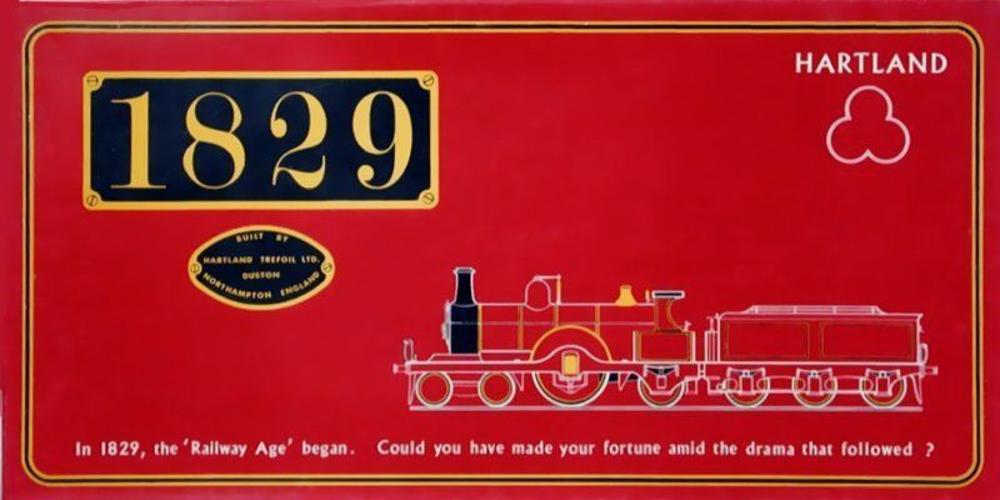
1829
Designer: Francis Tresham
Francis Tresham's original 1829: the design that started the whole 18xx genre, set in southern England.
1829 — Summary
Capitalization type
- Full capitalization: once it floats (60% sold), the company receives its entire capital (par value × 10) at once — exactly as in 1830.
Floating percentage and per-player share limits
- Floats once 60% of shares are sold (same as 1830)
- No 60% ownership cap: a player may hold up to 100% of a single corporation, unlike 1830's 60% limit per shareholder
- Certificate limit per player: 3 players — 18; 4 players — 18; 5 players — 17; 6 players — 14; 7 players — 12; 8 players — 10; 9 players — 9
Starting cash by player count
- 3 players: £840 starting cash
- 4 players: £630 starting cash
- 5 players: £504 starting cash
- 6 players: £420 starting cash
- 7 players: £360 starting cash
- 8 players: £315 starting cash
- 9 players: £280 starting cash
- The bank always starts with £20,000; there is no 2-player variant
End game triggers
- The game only ends when the bank runs out of money — there's no "last train bought" trigger and no forced bankruptcy, since no company is ever required to buy a train
Number of phases
- 4 phases (2, 3, 5, 7), triggered by the purchase of the first 2-train, 3-train, 5-train and 7-train respectively (the 4-train doesn't open its own phase)
Train list and prices
- 2 train — £180 (7 units; rusts with the first 5-train)
- 3 train — £300 (6 units; rusts with the first 7-train)
- 4 train — £430 (5 units)
- 5 train — £450 (5 units)
- 7 train — £720 (4 units; buying it closes the private companies)
List of private companies
- Swansea & Mumbles (SM) — £30, revenue £5
- Cromford & High Peak (CH) — £75, revenue £10
- Canterbury & Whitstable (CW) — £130, revenue £15
- Liverpool & Manchester (LM) — £210, revenue £20
- Hull (HU) — £315, revenue £25
- Preston (PR) — £435, revenue £30
- Holyhead (HO) — £570, revenue £35
- Harwich (HA) — £720, revenue £40
- Dover (DO) — £900, revenue £45
List of corporations
- London & North Western (LNWR) — home at E8
- Great Western (GWR) — home at J11
- Midland (Mid) — home at E12
- London & South Western (LSWR) — home at J17
- Great Northern (GNR) — home at C14
- London Brighton & South Coast (LBSC) — home at L17
- Great Eastern (GER) — home at J17
- Great Central (GCR) — home at C12
- Lancashire & Yorkshire (LYR) — home at C8
- South Eastern & Chatham (SECR) — home at L21
Game-specific mechanics
- Track-laying via "survey parties": you may only build in the hex the survey token has just vacated
- Three built-in rule tiers (simple, intermediate, full)
- Up to 9 players depending on the chosen map setup (southern England and Wales, with a Northern Board variant)
- No company is ever required to buy a train (MUST_BUY_TRAIN: never)
Emergency sell
There's no emergency sell mechanic: like its 1830 successor's own predecessor, 1829 never requires a company to own a train in the first place, so the entire chain of president cash and forced share sales that defines 1830's mechanic simply never triggers here.
Comparison with 1830
1. Origin and timeline: here the comparison runs backwards
1829 isn't a game measured "against" 1830 — it's its direct ancestor. It began in the 1960s as "Mainline," a
generic track-and-shares game that Francis Tresham relocated to southern England and renamed 1829, after the
year of the Rainhill Trials, the dawn of the railway age. It was published in 1974 (Hartland Trefoil) after
twelve years of playtesting. 1830 didn't arrive until twelve years later (Avalon Hill, 1986), and was designed
by that same Tresham: it isn't a new game so much as a refinement of his own original design that went on to
become the reference point for the whole genre.
2. Map and number of players
1829 covers southern England and Wales (with a Northern Board variant from 1981 covering northern England and
Scotland) and supports 2 to 9 players depending on the setup chosen. 1830 narrowed this down: northeastern USA,
only for 2-6 players.
3. Three built-in rule tiers
1829 ships with three levels of complexity — simple, intermediate, and full — designed to bring new players in
gradually. 1830 dropped this staged structure and is always played with a single, unified ruleset.
4. Track-laying via survey parties
A mechanic unique to 1829 that no later game in the genre kept: each company moves a "survey party" token
across the hex grid, and a tile can only be laid in the hex that token has just vacated. 1830 removed this
entirely and replaced it with what we now consider the standard system: laying tiles in any hex connected to
your own network.
5. Floating and capitalization: 1830 left this untouched
Both games float their companies once 60% of shares are sold, and both pay out 100% of par value in full the
moment a company floats — the exact same formula, inherited by 1830 without any change at all.
6. A different exception to the certificate limit
In 1829, shares priced below £30 don't count toward a player's certificate limit. 1830 replaced that flat price
threshold with a specific zone of the stock chart (the yellow area): the criterion shifts from a numeric price
to a position on the board.
7. A different train ladder
1829 tops out at a 7-train, following a 2/3/4/5/7 progression (no 6-train, no Diesel). 1830 rewrote this into
the 2/3/4/5/6/Diesel progression that's now nearly universal across the rest of the genre.
8. Later rusting
In 1829, 2-trains hold on until the first 5-train is bought, and 3-trains until the first 7-train. 1830 moved
both triggers earlier, tying them to its own 4-trains and 6-trains respectively.
9. Terrain costs, nearly untouched
1829 already charged a financial penalty for building over mountains and rivers. 1830 kept this idea almost
unchanged, folding it into its own terrain cost table, which is now a genre standard.
10. The genre's own name comes from here
1829 is named for the year of the Rainhill Trials, the birth of the British railway age. 1830 kept that same
naming convention — christening the game after a real year — applied to the United States, which is why we
still call the whole genre "18xx" today.