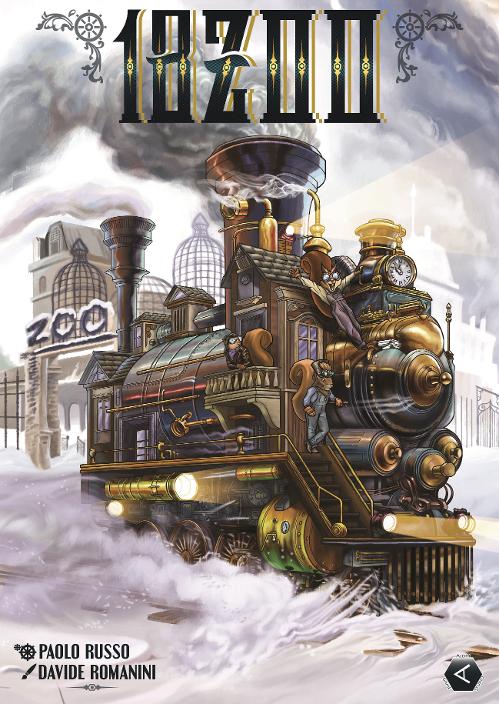
18ZOO
An 18xx starring anthropomorphic zoo animals, with an innovative stock market design and games of about two hours.
1. Setting, map and length
1830 covers the northeastern USA for 2-6 players, in games of 3-4 hours. 18ZOO moves the action to a zoo
populated by anthropomorphic animals, for 2-5 players, and cuts the length down to about 90-120 minutes -
roughly half- thanks to a modular map made of a central core plus up to 8 connectable sections, letting the
number of companies (1 to 8) and the game's size adjust to each group.
2. 20% shares, not 10%
In 1830 each company has 10 shares of 10% each. In 18ZOO companies start with just five 20% shares, and later
(in the final round) a sixth share is added, so each share becomes worth 1/6 of the company. Capitalization is
incremental throughout the game, not delivered in one lump sum at flotation like in 1830.
3. A stock market that does the math for you
In 1830 the market chart only shows the share price: players have to calculate the dividend (price × shares)
and check whether the price should rise. In 18ZOO every market cell shows three values at once: the current
price, the revenue threshold a run must clear to advance to the next cell, and the fixed dividend paid out -
stripping out almost all the arithmetic from a game that usually demands plenty of it.
4. Rising revenue thresholds instead of a simple "beat the price"
In 1830 the rule is simple: if the declared dividend is equal to or greater than the share's current price,
the price rises one step. In 18ZOO every successive market cell prints its own, ever-higher revenue threshold
that a company's run must clear to advance further: the higher a share already sits, the harder it gets to
push it up again.
5. A dividend bonus exclusive to the president
On the top ("blue") rows of 18ZOO's market, the president personally receives an extra dividend bonus on top
of the normal per-share payout - a targeted reward for reaching the top of the market with no equivalent in
1830.
6. Privates become "Powers": rule-benders, not income streams
1830's six privates basically just pay a fixed revenue each turn. 18ZOO replaces them with around twenty
"Powers/Inventions," priced at only $1-3 each, each one bending a specific rule of the game (a player may hold
up to 3 at once); they're also not all available at once, but revealed in batches (4 at the start, 4 more each
following round).
7. Powers can be resold at whatever price the owner picks
In 1830 privates are sold between players through negotiation or bidding at auction. In 18ZOO the owner of a
Power can freely set its resale price anywhere from $0 up to its face value, with no need to negotiate with
anyone - a much simpler, seller-controlled market for privates.
8. You can only found a company "neighboring" the last one launched
In 1830 a player can found any of the 8 companies as long as they can afford its president's certificate. In
18ZOO, after the first company is chosen freely, the "neighbour" rule requires every subsequently launched
company to be numerically adjacent to one already in play - a deliberate way of forcing territorial conflict
from the very start.
9. A shorter train progression, with two special car types
1830 runs the progression 2-3-4-5-6-Diesel. 18ZOO's basic progression only goes up to the 5-train, but adds
J-trains (which double a route's revenue) and permanent 4S trains, whose purchase advances a company directly
onto brown-level track - mechanics with no equivalent in 1830.
10. Fixed terrain that can never be upgraded
In 1830, virtually any tile can eventually be upgraded as new colors become available. In 18ZOO, villages/dits
and hills/mountains are deliberately never upgradable at all, permanently constraining the routes that pass
through them and making the terrain puzzle play out differently depending on which modular sections are in
use that game.
18ZOO — Schematic summary (vs 1830)
SETTING
- A themed zoo with anthropomorphic animals; 2-5 players, games of 90-120 minutes
- Modular map: central core + up to 8 connectable sections (1 to 8 companies)
STOCK MARKET AND SHARES
- 5 shares of 20% per company (not 10 of 10%); a sixth share added in the final round
- Incremental capitalization throughout the game
- Every market cell shows price, revenue threshold to advance, and fixed dividend all at once
- Rising revenue thresholds to climb the market, instead of 1830's simple "beat the current price"
- A dividend bonus exclusive to the president on the market's top rows
POWERS (PRIVATES)
- About 20 Powers/Inventions priced $1-3, revealed in batches (4 at the start, 4 per round after)
- A player may hold up to 3 at once
- Resold at whatever price the owner freely chooses (between $0 and face value)
FOUNDING COMPANIES
- The "neighbour" rule: every company launched after the first must be numerically adjacent to one already in play
TRAINS AND TERRAIN
- Short basic progression (up to the 5-train), plus J-trains (double revenue) and 4S trains (advance the company straight to brown track)
- Villages/dits and hills/mountains can never be upgraded