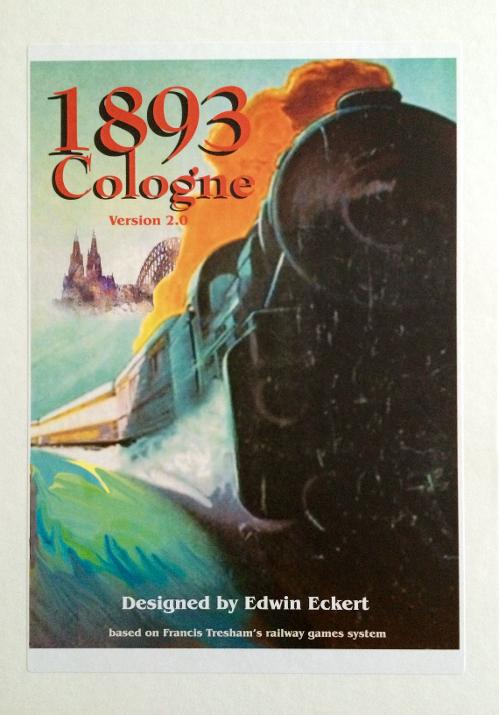
1893: Cologne
Cologne, with a Rhine crossable at only four hexes and minors that merge by shareholder vote, in a short 18xx for 2-4 players.
1. Setting, map and number of players
1830 covers the northeastern USA for 2-6 players. 1893 moves the action to the Rhine valley between
Düsseldorf and Bonn (with Cologne at the center of the map), designed for only 2-4 players and short games
of about 2.5 hours, much shorter than a typical 1830 game.
2. The "Starting Package" is bought through sequential offers, not an auction
In 1830 the six privates are awarded through a classic ascending auction. In 1893 the three privates (A, B,
C) and the five numbered minor companies are distributed through the "Starting Package": in turn, each
player may buy the topmost card in the package, buy the cheapest available minor company, or pass. If
everyone passes without buying the first still-available card, its price drops by 5 Mark and it is offered
again, and so on until someone buys it.
3. Almost no private can be resold between players
In 1830 all six privates can be freely bought and sold between players throughout the game. In 1893 only
the EVA (private B) can be freely sold between players (never to a company); the FdSD (A) must be
mandatorily exchanged for Rheinbahn shares during a stock round, and the HdSK (C) is exchanged for a 10%
HGK certificate at the moment that company is founded through a merger.
4. Minor companies that merge via shareholder vote
A mechanic that doesn't exist in 1830, where companies never merge with each other. In 1893 there are five
minor companies (numbered 1 to 5), each with a single starting station, that always pay out 50% of their
income to owners and keep 50% in treasury. Over time they mandatorily merge to form the AGV (minors 1, 3,
and 5) and the HGK (minors 2 and 4, plus private C), decided by a vote among the owners of the corresponding
exchange certificates.
5. Irregular certificate structure between companies
In 1830 every company has exactly 10 shares of 10% each. In 1893 the three starting companies (RB, DE, RSE)
have 1 director's certificate worth 20% plus 8 certificates of 10% (9 certificates in total), while the two
companies born from mergers (AGV and HGK) have 1 director's certificate of 20%, a second certificate of 20%,
and 6 of 10% (8 certificates in total).
6. Lower float threshold
In 1830 a company floats once 60% of its shares are sold. In 1893 it floats once just 50% has been sold for
the first time; upon floating it receives 10 times its par price from the bank as treasury, just like 1830's
full capitalization, but triggered at a lower threshold.
7. The Rhine can only be crossed at four points, two of which start closed
A concept that doesn't exist in 1830: the Rhine can only be crossed at four specific hexes (the southern
Düsseldorf/Neuss bridge, the Hohenzollern and southern Cologne bridges, and the Bonn-Oberkassel toll
crossing). During the starting yellow phase, two of these four points (the Hohenzollern bridge and the
Bonn crossing) remain closed and no tile may be laid there that crosses the river; only the other two
remain open until the green phase arrives.
8. No bank pool
In 1830 shares sold by a player go into a bank pool, from which other players can buy them. In 1893 there
is no pool: sold shares return directly to the stock market display, at the price in effect before the
sale, and dividends on shares sitting in the market are kept by the bank.
9. A train can be traded in for 50% credit
1830 has no mechanism for trading in trains; a company simply buys new ones. In 1893, during the train
purchasing step, a company may trade in at most one train it already owns for a new train, receiving a
discount equal to 50% of the traded-in train's printed price. The traded-in train moves into the Train
Pool and becomes available to other companies at its printed price.
10. One player's bankruptcy ends the entire game instantly
In 1830 bankruptcy usually leads to a company being liquidated, but the game continues with the remaining
players. In 1893, if a director is forced to buy a train and, after selling all the shares they can, still
cannot cover the shortfall, that player is declared bankrupt and the game ends immediately for everyone.
1893 — Schematic summary (vs 1830)
SETTING
- Rhine valley between Düsseldorf and Bonn, with Cologne at the center
- 2-4 players, short games (~2.5 hours)
COMPANIES AND PRIVATES
- "Starting Package" (3 privates + 5 minor companies) bought through sequential offers with price reduction if everyone passes, instead of an ascending auction
- Only EVA can be freely sold between players; FdSD and HdSK are mandatorily exchanged for shares when their corresponding companies merge
- 5 minor companies (fixed 50%/50% dividend) that merge via shareholder vote to form AGV and HGK
- Irregular certificates: 9 per company at RB/DE/RSE (1x20%+8x10%), 8 per company at AGV/HGK (2x20%+6x10%)
STOCK MARKET
- Floats at 50% of shares sold (vs 60% in 1830), with full capitalization (10x par price)
- No bank pool: sold shares return directly to the market display
THE RHINE
- Only 4 crossing points; 2 (Hohenzollern bridge and Bonn crossing) remain closed until the green phase
TRAINS AND GAME END
- A train you own can be traded in for a new one at a 50% discount off its price
- Game ends when the bank runs dry during an operating round, or immediately if a player goes personally bankrupt