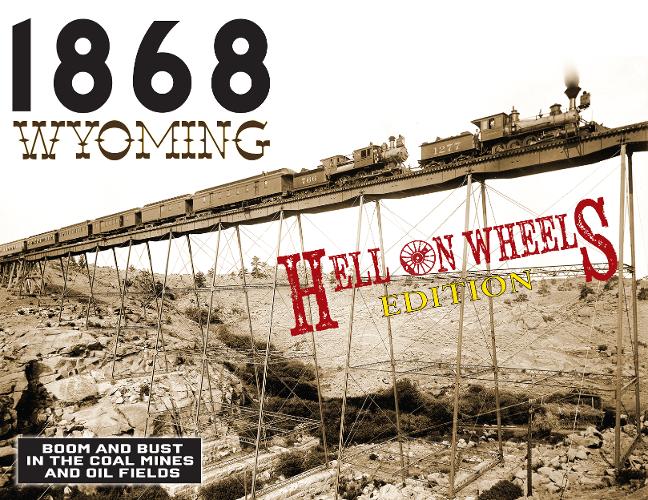
1868: Wyoming
Wyoming with coal mines and oil fields developed in their own dedicated rounds, in a modern and highly tactical 18xx.
1. Setting, map and number of players
1830 covers the northeastern USA for 2-6 players. 1868: Wyoming is a modern, highly tactical 18xx ("Hell on
Wheels" meets classic 18xx) with 10 major railroad companies competing on a large map, offset by a much faster
track-laying pace than a map that size would normally allow. On top of the standard game, it also ships a
dedicated 2-player variant with adjusted certificate limits and starting cash.
2. Coal mines and oil fields as investments separate from the railroads
Absent from 1830, which has no resource layer at all. In 1868: Wyoming players separately manage and invest in
coal and oil companies, whose development raises the revenue that railroad companies' trains can collect in
that area — but that development needs sustained investment to hold, unlike a 1830 city's fixed, printed
value.
3. Uranium as a high-risk development track
In 1830 every income source is static and predictable. 1868: Wyoming adds uranium as a further development
type, explicitly described as driving "the biggest boom and the biggest bust" — a resource with a bigger payoff
but also more collapse risk than coal or oil.
4. Boomtowns that can grow, shrink, or vanish entirely
1830's towns and cities carry a fixed value on the map forever. In 1868: Wyoming, boomtowns can grow into
cities if enough development happens nearby, shrink back down to towns if that development dries up, or even
disappear as ghost towns for good — a genuinely living, reversible map.
5. Frontier Forts with a bonus that fades over time
1830 has no time-limited bonuses. 1868: Wyoming's Frontier Forts grant a revenue bonus to trains passing
through, but that bonus declines over time, rewarding players who reach them early rather than late.
6. A huge, rotating pool of thematic privates
1830 uses the same fixed 6 privates in every game. 1868: Wyoming has 21, depicting real historical figures and
events (surveyors, explorers, financiers, politicians, oil companies, small railroads), but only 11 are
actually in play in any given game — the available roster changes from session to session.
7. Credit Mobilier: a construction company that isn't a private
Nothing like this exists in 1830. In 1868: Wyoming, Credit Mobilier is a distinct construction company (not one
of the 21 privates) that pays out to Union Pacific's shareholders specifically for building track, weaving the
real historical financing scandal that gave it its name directly into the economic engine.
8. The Golden Spike bonus for completing the transcontinental link
1830 has no "first to connect X and Y" historical bonus. 1868: Wyoming rewards whichever train is first to run
the full Omaha-to-Promontory Summit route with a bonus that also permanently opens up revenue in that area
afterward.
9. The Northern Spike as a second, symmetric milestone
On top of the Golden Spike, 1868: Wyoming has a separate Northern Spike bonus for the first train to run from
an eastern off-board location to Independence Creek, Montana — likewise permanently opening revenue in that
area once reached, doubling the number of these historic race objectives compared to 1830, which has none.
10. Resource development handled outside the normal round sequence
1830 only ever alternates stock rounds and operating rounds. In 1868: Wyoming, developing coal, oil, and
uranium has its own dedicated space, set apart from normal train operations, giving the resource economy a
structural presence in the game's round sequence that 1830 simply doesn't have.
1868 Wyoming — Schematic summary (vs 1830)
SETTING
- Modern, tactical 18xx, 10 major railroad companies, large map with fast track-laying
- Dedicated 2-player variant, on top of the standard game
RESOURCE DEVELOPMENT
- Coal and oil companies managed and funded separately from the railroads; development needs sustained investment to hold
- Uranium as a high-risk, high-reward development track
- Boomtowns that grow into cities, shrink to towns, or disappear as ghost towns based on nearby development
- Frontier Forts: a revenue bonus that decays over time
- Development has its own space outside the standard stock/operating round sequence
PRIVATES AND CREDIT MOBILIER
- 21 privates based on real historical figures and events; only 11 in play per game
- Credit Mobilier: a construction company (not a private) that pays Union Pacific shareholders for building track
HISTORICAL BONUSES
- Golden Spike: bonus and permanent revenue for the first Omaha → Promontory Summit train
- Northern Spike: bonus and permanent revenue for the first train from the east to Independence Creek (Montana)