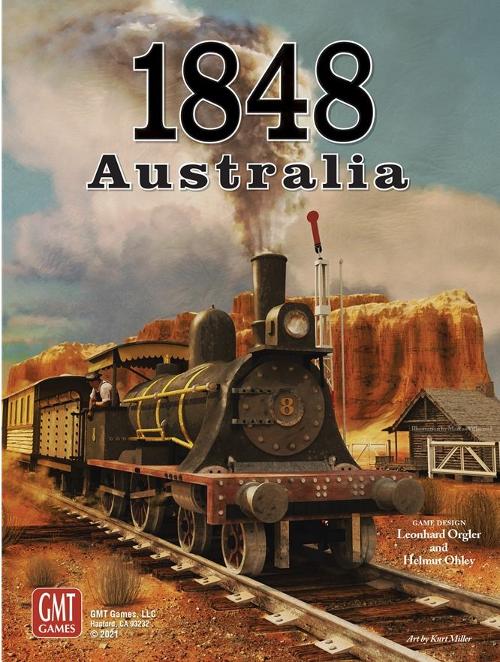
1848: Australia
Australia with three track gauges and the Bank of England as a public company that bails out railways in receivership.
1. Setting, map and number of players
1830 covers the northeastern USA for 2-6 players. 1848 covers the whole of Australia and is designed for 3-6
players (no 2-player option like 1830), built on the same 1829/1830 lineage but organized around the historical
rivalry between the Australian colonies and their three different track gauges.
2. Three track gauges and gauge-change markers
A mechanic absent from 1830: on the 1848 map, each hex's background color signals one of three track gauges
(narrow, standard, broad). Whenever a route crosses the border between two gauges, a white gauge-change disk is
placed between the hexes, counting as a zero-value station within the train's range. Plus-trains (2+, 3+...)
get one extra gauge-change marker on top of their normal range.
3. The Bank of England as a ninth, shared company
Nothing like this exists in 1830. In 1848 the Bank of England is a separate entity with 10 shares at 10% each,
jointly held by all players: its price never moves up or down through normal share trading, and it pays an
increasing minimum dividend by phase (£0 in yellow, £100 in green, £200 in brown, £300 in gray).
4. Bankruptcy resolved by Bank of England receivership
In 1830 bankruptcy falls directly on the company or its president. In 1848, once a company's share price hits
the leftmost column of the price chart, the Bank of England takes it over outright: it first compensates other
shareholders at the initial share price, then the company's trains and papers are removed from the game, and
its station tokens are flipped and stay on the map, generating income (based on the value of the cities under
them) that boosts the Bank of England's own dividend.
5. Loans that move the Bank of England's own share price, not just the borrower's
Starting with the sale of the first 3/3+ train, a company can take out £100 loans from the Bank of England
(which are never repaid): each loan shifts the borrowing company's share price 2 or 3 spaces left, while also
pushing the Bank of England's own price up. Companies can take up to 5 loans voluntarily (more only to fund a
mandatory train purchase), and the Bank has a hard cap of 20 loan markers overall.
6. Four end-game triggers, none of them "the last train"
In 1830 the game ends when the bank runs dry or the last train of the last type is bought. 1848 drops that
second trigger entirely and replaces it with four of its own: the bank running out of money, a company's share
price hitting the top of the chart, the Bank of England having issued 16 or more loans, or five or more
companies sitting in receivership.
7. Privates that hand over concrete shares when purchased
1830's 6 privates only grant income and, occasionally, a minor power. 1848 also has 6, but two are much
stronger: the Trans-Australian Railway gives its owner a 10% share in the Commonwealth Railways the instant
it's bought, and the North Australian Railway hands its owner the Director's Share of the Central Australian
Railway outright, which then starts with a £100 par price.
8. One company with a double bar to floating
In 1830 any company floats and starts operating as soon as 60% of its stock is sold. In 1848 the Commonwealth
Railways needs the usual 60% sold plus a notional infinite-range train able to travel from Sydney to Adelaide:
until that second condition is also met, the company stays dormant even if fully subscribed.
9. A permanent train that only reaches one single off-board point
1830's Diesel is just a bigger standard train. 1848's 2E train, "The Ghan" (permanent, unlimited supply,
£200), can only run a two-station route: from one of the company's own tokens to the off-board Alice Springs
location. It doesn't count toward a company's mandatory train-ownership requirement or against its train limit,
and each company may only ever own one.
10. A stacking bonus for touching the game's "K" cities
In 1830 a route's income is just the sum of the city and town values it passes through. 1848 adds the K-K
bonus on top: an extra £50, £100, £150 or £200 for a train's route touching 2, 3, 4, or all 5 of the map's
designated K-cities — a bonus "The Ghan" can never receive.
1848 — Schematic summary (vs 1830)
SETTING
- The whole of Australia, 3-6 players (no 2-player option like 1830)
- Three track gauges marked by each hex's background color; gauge changes count as a zero-value station within a train's range
BANK OF ENGLAND AND RECEIVERSHIP
- A ninth entity jointly held by all players: 10 shares at 10%, minimum dividend rising by phase (£0/100/200/300)
- Companies whose price hits the bottom column go into receivership: shareholders compensated, trains removed, flipped tokens keep generating income for the Bank
- £100 loans from the first 3/3+ train onward: never repaid, shift the borrowing company's price down and push the Bank's own price up; hard cap of 20 loans total
PRIVATES AND COMPANIES
- 6 privates; two hand over shares directly (Trans-Australian Railway → 10% of the COM; North Australian Railway → Director's Share of the CAR, starting at £100)
- The Commonwealth Railways needs 60% sold plus a notional Sydney-Adelaide link before it can start operating
TRAINS
- "The Ghan" (2E): permanent, unlimited train running only a 2-station route to Alice Springs; doesn't count toward the mandatory train-ownership rule or the train limit
- Stacking K-K bonus (£50/100/150/200) for touching 2, 3, 4, or 5 "K" cities on a single route
END OF THE GAME
- No "last train bought" trigger (unlike 1830)
- Four of its own triggers: bank runs dry, a share price hits the top of the chart, 16+ Bank of England loans, or 5+ companies in receivership