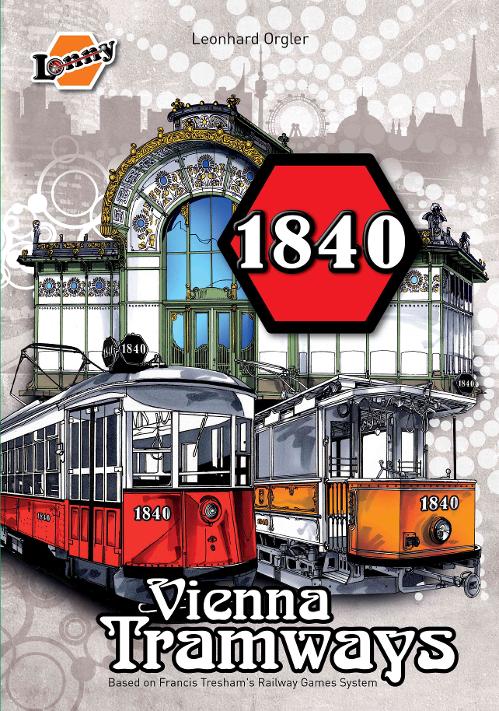
1840: Vienna Tramways
Vienna trams with no train rusting at all: every line is a "diesel" from the start, and obsolescence is replaced by ongoing fees.
1. Setting, map and number of players
1830 covers the northeastern USA for 2-6 players. 1840 moves the action to the city of Vienna and its
tramway network, also for 2-6 players, but with a much more urban focus: instead of railways between cities,
you build tram lines connecting stops and interchanges within a single city.
2. Every player must direct exactly one tram company
In 1830 a player can end up directing several companies or none. In 1840 every player must own exactly one
Tram Company, no more, no less: in the first stock round everyone is required to buy the director's
certificate of a different TC, worth 50% of the company (not the usual 20% from 1830), though it only counts
as a single certificate against the certificate limit.
3. Trams never rust: instead, they pay growing maintenance fees
In 1830 older trains become obsolete and are removed once a certain train type appears. In 1840 trams never
rust: the first time a tram of a new color is bought, older trams the company still owns start suffering a
maintenance cost deducted from their income (for example, a yellow tram costs -50 Gulden once the first red
tram is bought, and -400 once the first purple tram is bought). Pink trams never incur maintenance costs,
and purple trams always add a fixed +200 Gulden to their revenue.
4. Variable-size dividends that move the share price by a graduated amount
In 1830 paying a dividend usually moves the share price a single fixed step, regardless of the amount. In
1840 the director decides how many Gulden to pay out (always multiples of 10), and the share price moves a
different number of spaces depending on the total amount paid: 10 to 90 Gulden doesn't move it at all, 100
to 190 moves it 1 space, and it can move as much as 7 spaces if the dividend exceeds 2,500 Gulden.
5. Director-less Stadtbahn companies that always pay out 100% of income
A concept that doesn't exist in 1830: the four Stadtbahn companies (W, V, G, D) never have a director. They
operate automatically along a pre-printed route over the tiles already laid, and always pay out 100% of
their income as dividends; they can never retain money in treasury.
6. Two-tier structure: companies buy "lines" that actually build track and run trams
In 1830 a company builds tiles and runs trains directly. In 1840 each Tram Company may own up to three
"lines" (numbered 1 to 18), bought at auction during the company round; it's those lines, not the company
itself, that lay tiles, place station markers, and run a tram to generate income during each line round.
7. Private companies ("landmarks") tied to map monuments, not resellable between players
In 1830 all six privates can be freely resold between players throughout the game. In 1840 the six privates
(called "landmarks," each tied to a specific Vienna monument, such as the Stephansdom or the Hofburg) are
auctioned at the start just as in 1830, but once won they can only be sold to a tram company (never to
another player), and while a player owns one it pays a fixed dividend every company round.
8. Much more complex round structure: Pre-Share, Share, Company, and Line rounds
In 1830 the cycle is simple: a stock round followed by operating rounds. In 1840 the game alternates through
four different round types along a fixed round track: a pre-share round auctioning off the privates, stock
rounds where shares are bought, company rounds where income is managed and trams and lines are bought, and
line rounds where each individual line lays tiles and runs its tram.
9. Fixed game length, not tied to bank exhaustion or the last train
In 1830 the game ends when the bank runs dry or the last available train of the final type is bought. In
1840 the game has a predetermined length: it always ends at the end of the sixth company round (CR6),
regardless of any economic condition.
10. Loans to force tram purchases when money runs short
In 1830, if a company can't pay for a mandatory train, the burden falls on the president and, ultimately, on
liquidating the company. In 1840, if a company has no tram at the end of the tram-buying rounds and the
director doesn't have enough personal cash to complete the mandatory purchase, they must take out loans from
the bank (100 Gulden each); loans are never repaid, but each one deducts 200 Gulden from the player's final
wealth.
1840 — Schematic summary (vs 1830)
SETTING
- Vienna's tramway network; 2-6 players
- Building urban lines between stops and interchanges, not railways between cities
COMPANIES
- Every player directs exactly one Tram Company (50% director's certificate, but counts as a single certificate)
- 4 director-less Stadtbahn companies, running automatically, that always pay out 100% of income
- Tram Companies buy "lines" (up to 3 per company) that are the ones that lay tiles and run the trams
- 6 privates ("landmarks") tied to monuments, only resellable to a company, never between players
TRAMS AND DIVIDENDS
- No tram ever rusts; when a new color is first bought, older trams accrue a growing maintenance cost
- Pink trams have no maintenance cost; purple trams add a fixed +200 Gulden to income
- Variable-size dividend (multiples of 10 Gulden) that moves the share price 0 to 7 spaces depending on the total amount paid
ROUND STRUCTURE AND GAME END
- Four-round cycle: Pre-Share, Share, Company, and Line Round
- Fixed ending: the game always ends at the end of company round 6 (CR6)
- Bank loans (100 Gulden) for mandatory tram purchases without enough treasury, at a -200 penalty in the final reckoning